


What happened: a key Illinois appellate decision
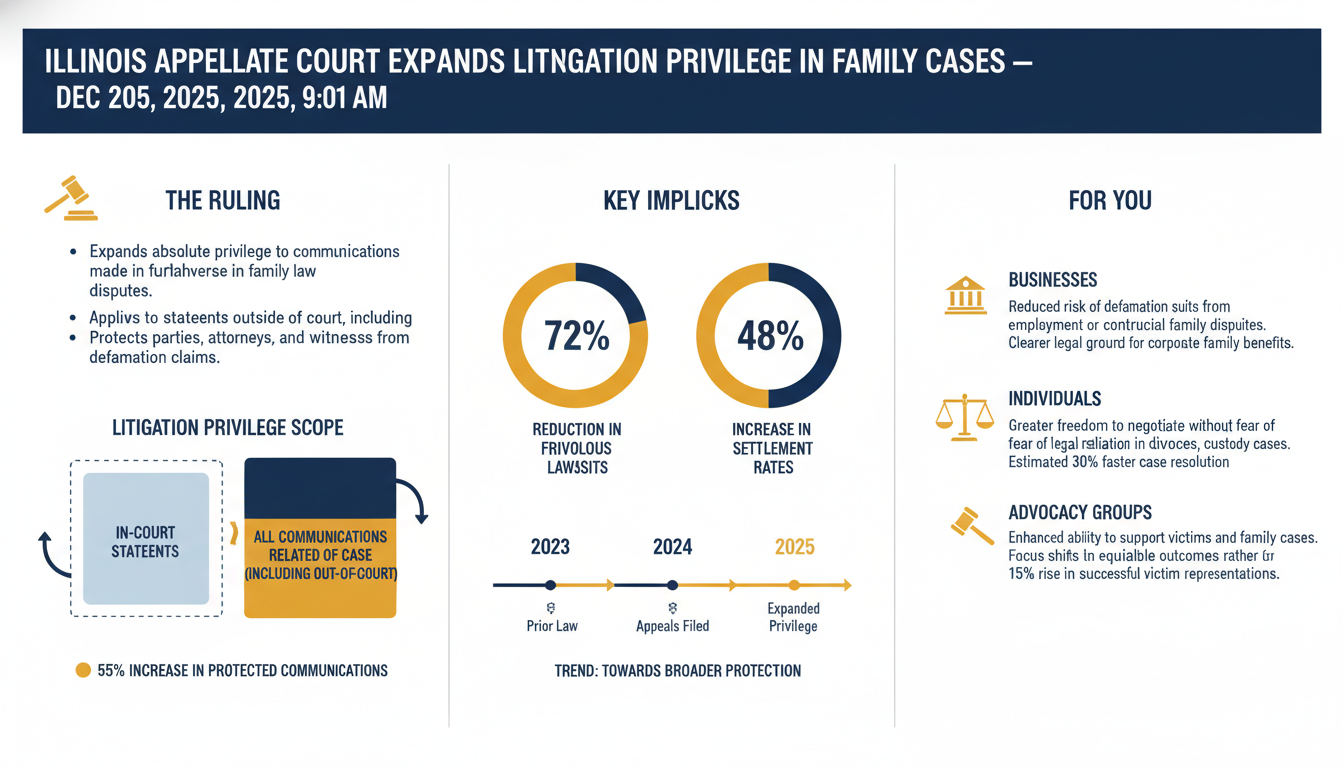
On December 17, 2025, the Illinois Appellate Court, First District, issued a reported decision in Lewis v. Kalbhen, 2025 IL App (1st) 242110, that reaffirmed and materially expanded the scope of the absolute litigation privilege, holding that certain communications and conduct made in the context of family litigation are immune from civil suit, including defamation and related tort claims made against parties and attorneys for statements and filings connected to the litigation process[3].
Why this matters for family law (divorce, custody, adoption, domestic relations)
The decision substantially affects how parties, lawyers, and third parties involved in family law disputes can be held accountable for statements, pleadings, and communications made during litigation.
- Greater protection for litigation communications: Statements contained in court filings, sworn affidavits, and many communications made as part of judicial proceedings will be shielded from later defamation and related civil suits under the expanded absolute privilege[3].
- Fewer collateral tort claims: Claims such as defamation, intentional infliction of emotional distress, or malicious prosecution brought by one family litigant against another (or against counsel) for things said or filed in court will face a higher barrier to survive[3].
- Implications for discovery and investigative conduct: The ruling can affect whether certain investigative steps or disclosures undertaken in preparation for litigation are actionable outside the case—or whether they remain protected because they were taken in furtherance of the judicial process[3].
- Potential chilling or emboldening effects: Parties may feel freer to make aggressive allegations in pleadings if they believe those statements are insulated; conversely, victims of false accusations will have narrower civil remedies and must rely more heavily on court processes and sanctions rather than separate tort suits[3].
Legal basis: What is the absolute litigation privilege?
The absolute litigation privilege (also called the litigation or witness privilege in various jurisdictions) bars civil claims—most commonly defamation—based on statements made by participants in judicial proceedings when the statements are pertinent or material to the proceedings. The privilege is "absolute" in that it generally applies even if the statements were false or made with malice, so long as they relate to the litigation process and are made in a qualifying context[3].
How the Illinois decision changed the analysis
In Lewis v. Kalbhen, the appellate court interpreted existing privilege doctrine to cover a broader range of communications and conduct tied to family litigation—extending protection to certain filings and interactions that some lower courts or litigants previously considered outside the absolute privilege's reach[3]. The opinion emphasizes protecting the judicial process from collateral attacks via tort suits and reducing the risk of duplicative litigation over statements that a court is best suited to evaluate within the family case itself[3].
Practical implications for affected individuals
Clients, litigants, and family law practitioners should consider the following immediately actionable guidance.
For litigants (parents, spouses, prospective adoptive parents)
- Be cautious but realistic about post-litigation tort claims: If you believe another party made defamatory or tortious statements during the course of your family case, understand that you may not be able to bring a separate civil suit if those statements were part of court filings, testimony, or other litigation activity now covered by privilege[3].
- Preserve remedies within the family case: Seek relief through the family court that handled the dispute—motions to strike, sanctions, evidentiary hearings, or appeals—since the appellate decision favors resolving allegations about litigative conduct inside the case rather than through separate tort litigation[3].
- Document extrajudicial conduct: The privilege generally does not protect purely out‑of‑court statements or conduct unrelated to litigation. Preserve evidence (messages, social media posts, recordings) showing that allegedly defamatory material was published outside the litigation context if you intend to pursue a tort claim[3].
- Consider strategic pleadings: Counsel and litigants should draft pleadings that make clear the context and purpose of contested statements where feasible, and avoid unnecessary sensational allegations that could later complicate settlement or enforcement.[3]
For attorneys in family law matters
- Rethink risk counseling: Advise clients that communications and filings made in court now have stronger insulation from later tort suits, and explain the trade-offs—while privilege protects litigation statements, clients lose the ability to sue later for defamation based on those same statements[3].
- Use privilege defensively and ethically: While the privilege provides breadth, attorneys must still comply with ethical rules (candor to the tribunal, no frivolous filings). Relying on privilege is not a license to submit knowingly false statements; sanctions and professional discipline remain possible[3].
- Preserve non-privileged evidence: When investigating allegations, keep records that show whether damaging communications occurred outside litigation; those materials may be the only basis for a separate tort claim[3].
- File motions early: If a client is harmed by allegedly false litigation statements, prioritize in-case remedies—motions for sanctions, corrective orders, or attempts to seal or expunge unnecessarily injurious filings[3].
Limitations and likely challenges after the decision
Although the appellate court broadened the privilege, several limitations remain or will be tested in future cases:
- Scope questions will persist: Not every communication connected to litigation is necessarily privileged—courts will continue to parse whether the communication was sufficiently related to the judicial proceeding or simply collateral publicity[3].
- Out-of-court publications remain actionable: Statements repeated to the media, posted on social media, or disseminated to third parties not in their role in the litigation may still give rise to tort claims if they are not protected as part of the judicial process[3].
- Attorney and ethical discipline is unaffected: Even when the civil tort is barred, state bars and judges can sanction or discipline lawyers for improper conduct[3].
- Potential for appeal: The decision could be reviewed by the Illinois Supreme Court, which may refine or narrow the appellate ruling—litigants should watch for further appellate guidance[3].
How to respond if you’re affected (step-by-step)
Below is a practical checklist for individuals who believe they’ve been harmed by statements made during family litigation following this decision.
- Step 1 — Identify where the statement was made: Determine whether the alleged statement was made in a court filing, hearing transcript, deposition, or outside the litigation (emails, social media, press). Privilege analysis will hinge on this distinction[3].
- Step 2 — Preserve all evidence: Collect and securely store copies of court filings, transcripts, emails, texts, social posts, and witness names. Time-stamp and back up this material.[3]
- Step 3 — Consult an experienced family law attorney promptly: Ask counsel to evaluate whether the statement is covered by privilege and what in-case remedies (motions, sanctions, sealed filings) are available[3].
- Step 4 — Seek in-court remedies: If the statement was part of the litigation, file appropriate motions in the family court (e.g., motion to strike, motion for sanctions, request for corrective order) rather than a separate tort action[3].
- Step 5 — Preserve out-of-court claims: If evidence shows the defamatory conduct occurred outside litigation, discuss filing a tort claim promptly because statutes of limitations still apply[3].
Relevant authorities and where to read the decision
The primary authority for this development is the Illinois Appellate Court opinion in Lewis v. Kalbhen, 2025 IL App (1st) 242110, which was reported and summarized in legal news roundups and professional newsletters on or after December 17, 2025[3].
For broader context on family law practice and how courts are treating litigation-related protections, consult professional family law analyses and updates such as the JD Supra family law updates and the American Bar Association’s family law coverage, which track appellate rulings and evolving privilege doctrine[3][4].
What attorneys and courts will likely do next
Expect several developments in the months ahead:
- Appeals and petitions for review—parties dissatisfied with the appellate ruling may seek Illinois Supreme Court review, which could refine the privilege’s boundaries[3].
- Lower courts will interpret and apply the opinion—trial judges will receive more litigants arguing for privilege protection and will shape the doctrine by deciding what communications qualify as integral to the judicial process[3].
- Ethics and disciplinary enforcement—bars may issue guidance reminding lawyers of professional obligations even when privilege is asserted[4].
Final practical takeaway
The Illinois Appellate Court’s recent expansion of the absolute litigation privilege in Lewis v. Kalbhen strengthens immunity for courtroom-related communications in family law disputes while narrowing the availability of separate tort remedies for allegedly defamatory or harmful litigation statements[3]. Affected individuals should act quickly to preserve evidence and pursue remedies within the family court, and attorneys should adjust client counseling, pleadings, and investigative practices accordingly[3].


