


Immigration Court 2026: DOJ Hiring Changes & What They Mean for Your Case
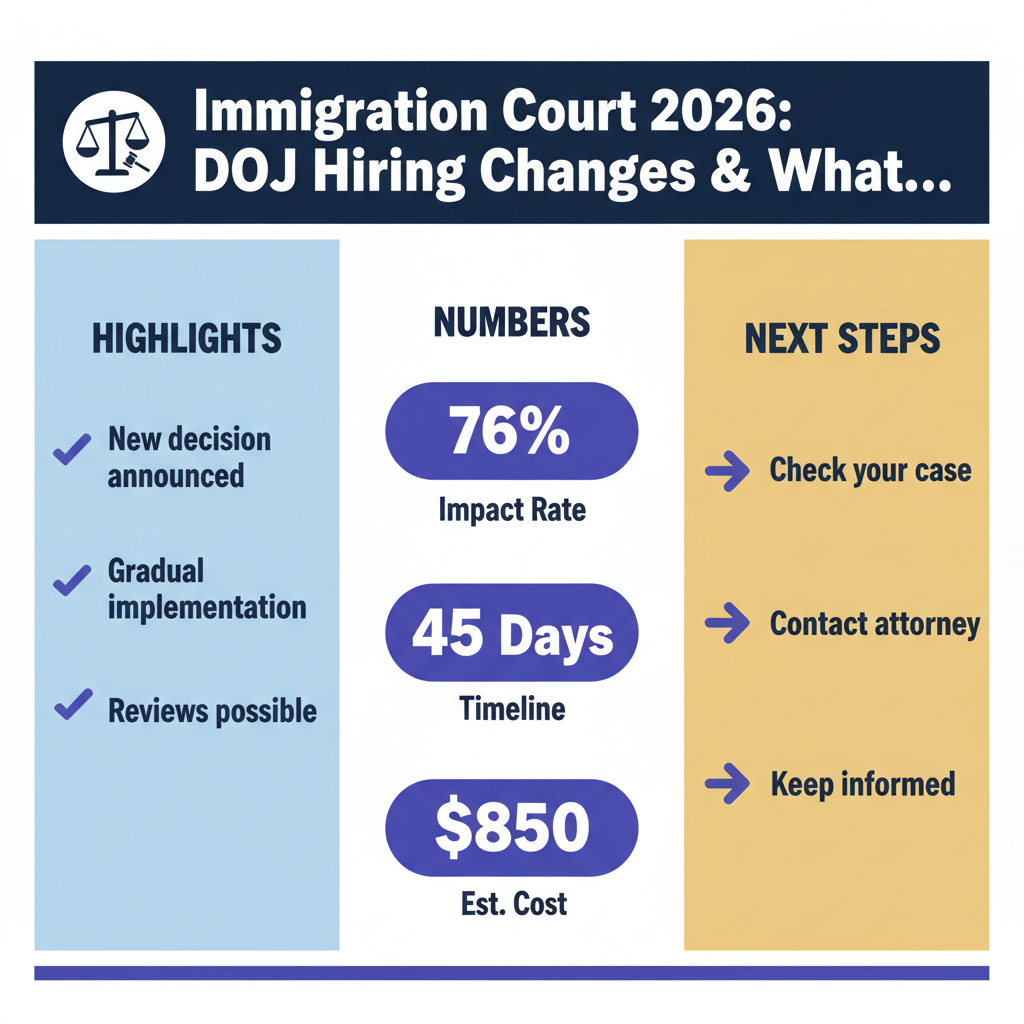
If you have a pending immigration court hearing, a family petition waiting for approval, or a work visa that depends on timing, the Department of Justice's 2026 hiring priorities may directly affect your case. The DOJ has made a significant shift: immigration adjudication roles—including deportation judges and policy-focused legal positions—are now at the top of the federal hiring list. This isn't just bureaucratic news. It means your immigration court could receive more judge capacity, faster case scheduling, and less flexibility for continuances. Understanding these changes now gives you time to prepare before your next hearing.
What's Actually Changing in Immigration Courts This Year
The DOJ's emphasis on hiring more immigration judges and related legal staff signals a fundamental operational shift.[1] When courts gain judge capacity, case scheduling accelerates. Judges who previously had months-long backlogs can now reset hearing dates sooner. Continuances—the delays that have traditionally given immigrants time to gather documents, find attorneys, or complete filings—become harder to obtain.[1]
This matters because immigration court has historically moved slowly. Families waiting on removal decisions, workers whose status depends on timing, and immigrants with prior arrests have often relied on extra months to prepare. That cushion is shrinking.
The shift also reflects a broader enforcement priority. More judges means more cases can move through the system faster, which generally favors the government's efficiency goals. For immigrants, this translates to: your court date may come sooner than expected, and you need to be ready when it does.
Who Feels the Impact First
Several groups should pay immediate attention to these changes:[1]
- People with pending immigration court hearings who have been relying on continuances to finish filings or gather evidence
- Families waiting on a court decision to avoid separation
- Workers and students whose immigration status depends on timing, travel, or clean criminal records
- Immigrants with prior arrests where criminal records and immigration consequences overlap
If you fall into any of these categories, the time to act is now—before your hearing gets moved up.
Certified Criminal Dispositions: Get Them Now
One of the most critical actions you can take immediately involves your criminal history—even if your charges were minor or resolved years ago.
Immigration decisions often depend on the exact language of charges and final outcomes, not what you remember about the case.[1] A misdemeanor you thought was dismissed, a plea deal you made quickly, or a charge that was reduced—all of these require official documentation to prove to the immigration court what actually happened.
Here's what you need to do:
- Contact the courthouse where you were charged and request a certified final disposition for each case
- Request official court documents, not just a printout from an online system
- Get certified copies (usually $5-15 per document) with the court clerk's official seal and signature
- Do this immediately—don't wait until your hearing is scheduled
Why certified? Immigration judges and USCIS officers require official documentation. They cannot base decisions on your word or informal records. A certified disposition proves exactly what charge you faced, what you pleaded to, what the sentence was, and when the case closed.
If you were charged in multiple jurisdictions (different counties or states), you need dispositions from each one. This process can take 2-4 weeks, so start now.
Gather Supporting Documents Before Your Hearing Gets Moved
With faster case movement, you won't have the luxury of months to organize paperwork. Gather these documents now:[1]
- Birth certificate (original or certified copy)
- Marriage certificate (if applicable, certified copy)
- Children's birth certificates (for family-based cases)
- Employment letters from all employers in the past 3-5 years, showing job title, dates, and salary
- Tax returns (personal and business, if self-employed) for the past 3 years
- Bank statements showing financial stability (last 3-6 months)
- Lease or mortgage documents proving residence
- Medical records (if health conditions are relevant to your case)
- Letters of support from employers, community members, family, or organizations
- School records (if you have children in U.S. schools)
- Proof of community ties (church membership, volunteer work, organizational involvement)
Organize these into a folder or binder now. Don't wait for your attorney to ask. Immigration judges appreciate applicants who arrive prepared.
How Court Timeline Changes Affect Different Cases
The impact of faster scheduling varies by case type:
Removal Cases: If you're in removal proceedings, faster judge availability means your hearing could be rescheduled sooner. You cannot rely on traditional continuances to buy time. Your defense—whether it's cancellation of removal, asylum, or another form of relief—must be documented and ready.[1]
Family-Based Petitions: If a family member filed a petition for you, court decisions may come faster. This is generally positive, but only if your case is complete and accurate. Incomplete petitions or missing documents now become critical delays.
Work Authorization Cases: If your work permit or visa depends on court approval or timing, accelerated scheduling could work in your favor—if you're prepared. If you're not, a moved-up hearing could be devastating.
What to Do Right Now: A Three-Step Action Plan
Step 1: Verify Your Next Court Date (This Week)
- Contact your immigration attorney or local immigration court
- Confirm your next hearing date and location
- Ask whether your court has received additional judge assignments or staffing changes
- Update your address with the court if you've moved
Step 2: Gather Criminal Dispositions (This Week)
- List every jurisdiction where you've been charged (even minor charges)
- Contact each courthouse and request certified final dispositions
- Keep copies of your requests and follow up if documents don't arrive within 3 weeks
Step 3: Organize Supporting Documents (Within Two Weeks)
- Gather all documents listed above
- Organize them chronologically or by category
- Make copies (keep originals safe)
- Create a simple index so your attorney can find documents quickly
What If Your Hearing Gets Moved Up?
Even with preparation, a moved-up hearing date creates stress. Here's how to respond:
- Contact your attorney immediately if you receive notice of a rescheduled hearing
- Don't request a continuance without a strong reason (judges are granting fewer delays)
- Ask your attorney about your relief options and what evidence supports each one
- Be honest about gaps in your case so your attorney can strategize realistically
The Broader Picture: Why This Matters Beyond Your Hearing
The DOJ's 2026 hiring priorities reflect a broader policy shift toward faster immigration case processing. This isn't temporary. Courts that gain judge capacity rarely lose it. This means:
- Immigration court will move faster throughout 2026 and beyond
- Continuances will become genuinely rare rather than routine
- Preparation and documentation will matter more than ever
- Cases with incomplete evidence or unclear legal grounds will be harder to defend
For immigrants and their families, this creates both risk and opportunity. The risk is that you won't have time to prepare. The opportunity is that if you prepare now, your case can move forward faster—which benefits you if you have strong evidence and legal grounds for relief.
When to Seek Legal Help
If you don't already have an attorney, now is the time to hire one. Immigration law is complex, and the stakes are high. An experienced immigration attorney can:
- Review your case and identify the strongest relief option
- Advise you on criminal history implications
- Help you gather and organize evidence
- Represent you in court
- Request continuances only when genuinely necessary and likely to be granted
If cost is a concern, look for legal aid organizations in your state. Many offer free or low-cost immigration services to qualifying immigrants.
Final Thoughts: You Have Time Now, Use It
The DOJ's 2026 hiring changes aren't a crisis—they're a signal. The signal is: prepare now, don't wait until your hearing is scheduled, and don't count on extra months to get organized. Immigrants who take action this month will be ready when their court date arrives. Those who wait may find themselves unprepared for a hearing they didn't expect to come so soon.
Start with the three-step action plan above. Get your criminal dispositions. Organize your documents. Verify your court date. These steps take time and effort, but they're far easier to complete now than under the pressure of an accelerated court timeline.
Your case matters. Your family matters. Prepare like it.


