


New Border Policies in 2026: What Immigrant Families Need to Know
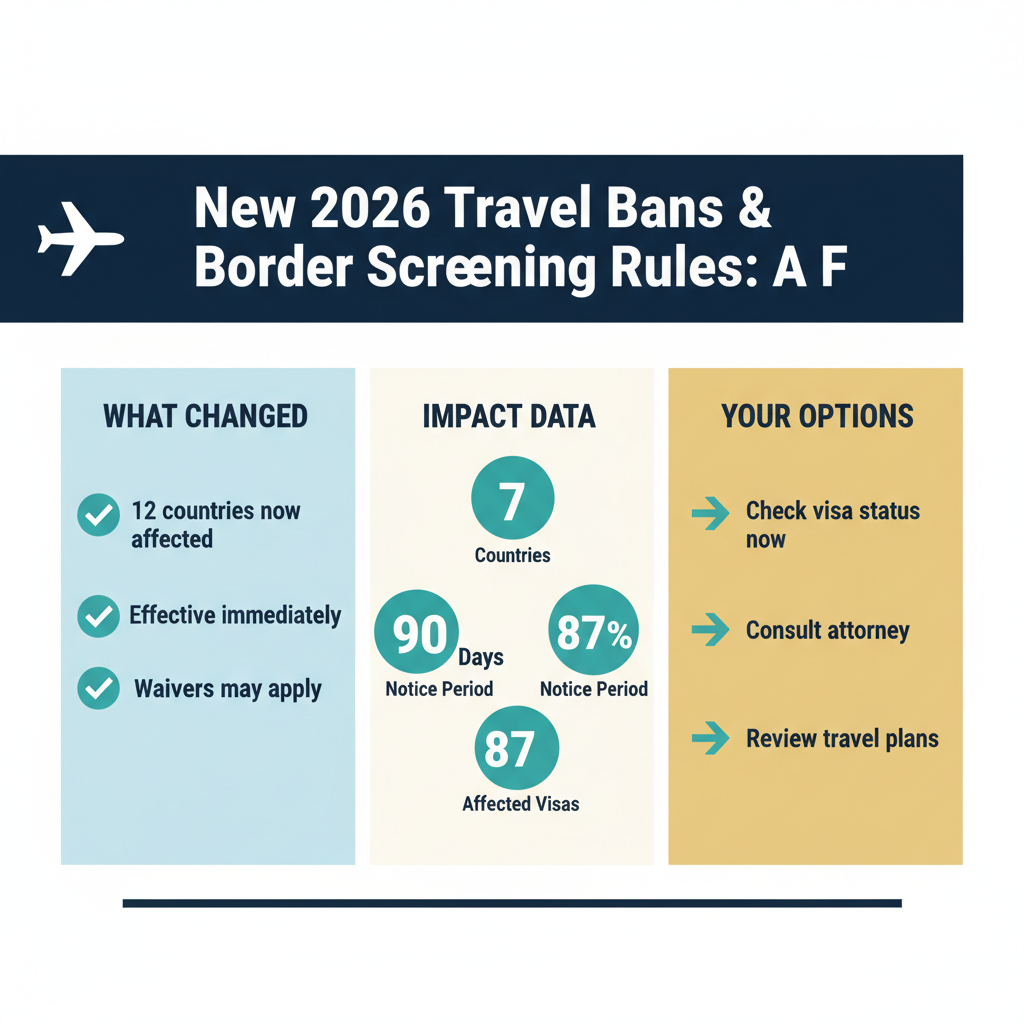
In early 2026, the U.S. government rolled out major changes to who can enter the United States and how people are screened at the border.[3][4] These changes affect tourists, students, workers, permanent residents, and people trying to reunite with family.
This guide explains the new travel bans, visa suspensions, biometric screening, and social media checks, and gives step‑by‑step, practical advice for immigrants and their loved ones.
1. Expanded Travel Ban and Visa Suspensions in 2026
1.1 Presidential Proclamation 10998: Who Is Barred From Entry?
On December 2025, the President issued Presidential Proclamation 10998, “Restricting and Limiting the Entry of Foreign Nationals to Protect the Security of the United States.”[5] It continues and expands the earlier “travel ban” policy and took full effect on January 1, 2026, at 12:01 a.m. EST.[6]
The Proclamation fully restricts and limits entry of nationals from a group of countries that U.S. authorities say have “deficient screening and vetting information.”[5] This includes:
- 19 countries with full suspension of entry (immigrants and nonimmigrants) under Proclamation 10949, which remains in effect, such as Afghanistan, Burma, Chad, Republic of the Congo, Eritrea, Haiti, Iran, Libya, Somalia, Sudan, Yemen, and others.[5][6]
- Additional countries added in 2025 including Burkina Faso, Laos, Mali, Niger, Sierra Leone, South Sudan, and Syria.[5]
- Individuals using travel documents issued or endorsed by the Palestinian Authority are also subject to the full suspension.[5]
For nationals of these countries, the Proclamation fully suspends entry as both immigrants and nonimmigrants unless a narrow waiver is granted or another exception applies.[5]
1.2 State Department Visa Issuance Suspensions (Effective Jan. 1, 2026)
The U.S. Department of State implemented the Proclamation by stopping or limiting visa issuance for affected nationals as of January 1, 2026.[6]
According to the State Department:
- Visa issuance is fully suspended for nationals of 19 countries named in the Proclamation (for both immigrant and nonimmigrant visas).[6]
- Visa issuance is partially suspended for nationals of another 19 countries; only certain visa categories may still be issued, subject to tight conditions.[6]
- Previous categorical exceptions for immediate family immigrant visas (IR‑1/CR‑1, IR‑2/CR‑2, IR‑5), adoption visas (IR‑3/IR‑4/IH‑3/IH‑4), and Afghan Special Immigrant Visas are no longer available under the new Proclamation.[6]
1.3 Who Is Covered and When?
Congressional analysis explains that the expanded travel ban applies to nationals of the listed countries who are outside the United States on January 1, 2026, and do not have a valid visa on that date.[8] In practice:
- If you are a national of a listed country and outside the U.S. without a valid visa on Jan. 1, 2026, you are generally barred from getting a new visa and entering, unless you qualify for a narrow waiver.[6][8]
- If you already have a valid visa or are inside the U.S., your situation is more complex and may depend on future renewals, changes of status, or travel plans.
2. Expanded Biometric Screening at Borders
2.1 Facial Recognition for All Non‑Citizens
On December 26, 2025, the Department of Homeland Security (DHS) implemented a new rule expanding its Biometric Entry/Exit program.[2][3] Under this rule, U.S. Customs and Border Protection (CBP) is authorized to:
- Collect facial biometrics from all non‑citizens upon both entry and exit at airports, land ports, seaports, and other authorized points of departure.[2][3]
- Use facial recognition technology to confirm identity and automatically match travelers to their travel documents.[2][3]
This policy applies to non‑citizens living legally in the U.S., including green card holders, not just visitors.[3]
2.2 What This Means at the Airport or Land Border
When you travel, you should expect:
- A CBP camera taking your photo at passport control or the boarding gate.
- Possible fingerprint or other biometric collection if CBP decides it is needed.
- More detailed questioning if the biometric match or your travel history triggers additional review.
3. Social Media and “Online Presence” Screening
3.1 ESTA and Tourist Screening
U.S. Customs and Border Protection has also moved toward mandatory social media collection for some travelers.[3] In a notice referring to Executive Order 14161 (January 2025), CBP stated that it is:
- Adding social media identifiers as a mandatory data element to Electronic System for Travel Authorization (ESTA) applications for Visa Waiver Program travelers.[3]
This means that many foreign tourists must now provide their social media handles as part of their pre‑travel authorization.
3.2 Increased Vetting of H‑1B and H‑4 Applicants
Guidance to employers and travelers notes that DHS has also expanded social media and “online presence” vetting for H‑1B and H‑4 applicants, along with other enhanced screening measures.[2]
Key points highlighted for employers and travelers include:[2]
- Social media content must be accurate and consistent with visa applications; deleting content can sometimes raise concerns.
- Nonessential international travel that requires visa stamping should be avoided if there is any risk of extended security checks.[2]
4. Practical Steps if You Are From an Affected Country
4.1 If You Are Inside the U.S. Right Now
If you are a national of one of the banned or visa‑suspended countries and are already in the United States, consider the following steps:
- Do not travel abroad unless absolutely necessary. If you leave, you may be unable to return because new visas are barred for many categories.[6][8]
- Review your current status and expiration dates. Check your I‑94 record, visa stamp, and any pending applications for extension or change of status.
- Explore alternative immigration avenues if possible, such as:
- Family‑based petitions through qualifying relatives who are U.S. citizens or permanent residents.
- Employment‑based petitions, where available.
- Asylum, withholding of removal, or protection under the Convention Against Torture if you fear persecution or harm in your home country.
- Keep full documentation with you. Carry copies of your passport, I‑94, approval notices, work authorization, and proof of residence (leases, utility bills).
- Consult with an experienced immigration attorney before making any travel decisions or major changes to your status.
4.2 If Your Family Member Is Abroad and Affected
If a spouse, child, or parent is outside the U.S. and affected by the travel ban or visa suspension:
- Identify exactly which rule applies. Confirm their nationality, the type of visa they need, and whether that category is fully or partially suspended under the State Department guidance.[6]
- Check for possible waivers. In past travel bans, waivers could sometimes be requested in cases of:
- Significant hardship if the person cannot enter.
- National interest or important public benefit.
- Lack of security concerns on the specific case.
- Document family and hardship factors. Collect:
- Marriage and birth certificates proving relationships.
- Medical records, financial documents, or school records showing hardship if separation continues.
- Evidence of clean background and compliance with any previous U.S. immigration rules.
- Avoid fraud or “shortcuts.” Do not attempt to use fake documents, third‑country passports, or misrepresentation; this can lead to permanent bars.
5. How to Prepare for Enhanced Biometric and Social Media Screening
5.1 Before You Travel
With expanded biometric screening and social media vetting, careful preparation can reduce surprises.
- Build “buffer time” into your travel plans. Employers are advised to add extra time for international travel and return‑to‑work dates because of possible delays at consulates and ports of entry.[2]
- Review your social media accounts.
- Make sure your name, employment, education, and travel history are consistent with your visa applications and résumés.
- Do not invent or alter information to “look better” to U.S. authorities.
- Be cautious about deleting large amounts of content immediately before applying; guidance emphasizes that accuracy and consistency, not content removal, are critical.[2]
- Confirm documents are valid and organized. Have:
- A passport valid at least 6 months beyond your planned stay, unless exempt.
- Valid visa or ESTA authorization, if applicable.
- Supporting documents (I‑20/DS‑2019 for students, job letters for workers, marriage certificates for derivative family members).
- Avoid nonessential consular visa stamping if you are in a sensitive category and DHS/USCIS warns of increased screening and shorter EAD validity periods.[2]
5.2 At the Port of Entry
When you arrive at a U.S. airport or land border:
- Expect to be photographed and possibly fingerprinted. This is now standard for most non‑citizens, including permanent residents.[2][3]
- Answer questions calmly and truthfully. CBP has broad authority to ask about your trip, work, and ties to your home country.
- Carry evidence of your ties and plans. For example:
- Return ticket for visitors.
- Employment verification letters, pay stubs, or school enrollment confirmations.
- If referred to secondary inspection:
- Stay calm; this does not automatically mean you will be denied entry.
- Answer clearly and consistently with your application and prior entries.
- Ask politely if you may call your attorney if things become complicated.
6. Special Considerations for Green Card Holders
Green card holders are also affected by some of these border policies, even if they are not subject to the travel ban itself.
- Biometric screening applies to lawful permanent residents (LPRs). DHS’s expanded rule expressly covers “all noncitizens,” which includes LPRs.[3]
- Extended trips abroad can still raise abandonment issues.
- Trips of 6–12 months may trigger questions about whether you still intend to live permanently in the U.S.
- Trips over 12 months without a reentry permit are particularly risky.
- Plan return trips carefully if you are from a listed country. Even if the ban targets new entries and visas, LPRs from affected countries may face more intensive questioning at the border.
- Keep strong proof of U.S. residence and ties (tax returns, lease or mortgage, employment records, school enrollment of children, U.S. bank accounts).
7. State‑Level Protections for Immigrant Communities in 2026
7.1 How States Are Responding
While federal authorities tighten border and visa rules, some states are taking steps to protect immigrants in their daily lives in areas like driver’s licenses, data privacy, and access to services.[7]
For example, state‑level measures discussed by policy organizations include:[7]
- Restricting use of motor vehicle records for federal immigration enforcement and creating penalties for unauthorized data sharing from DMV databases.[7]
- Limiting cooperation between state/local agencies and federal immigration enforcement in certain contexts, to encourage immigrants to report crimes and use public services without fear.[7]
7.2 Why This Matters If You Live in Florida
State policies can impact:
- Whether local police share information with federal immigration authorities.
- How safe you feel renewing a driver’s license or registering a vehicle.
- Your comfort in reporting crime, domestic violence, or wage theft.
Because these rules change often and vary by state, it is important to get state‑specific legal advice if you live in Florida or move between states.
8. Action Plan: How to Protect Yourself and Your Family in 2026
8.1 Immediate Steps (Next 30 Days)
- Iden


