


New H-1B Lottery Rules: What Changed for 2026–2027?
If you or a family member is hoping to work in the United States on an H‑1B visa, the lottery you’ve heard about is changing in a big way for the upcoming Fiscal Year (FY) 2027 cap season.
On December 23, 2025, the Department of Homeland Security (DHS) finalized a rule that replaces the old random H‑1B lottery with a wage‑weighted selection system starting February 27, 2026.[5][3] This new system will apply to H‑1B cap registrations filed in March 2026 for jobs starting on or after October 1, 2026 (FY 2027).[3][4][5]
This article explains what the new rules mean in practice, how they affect your chances, and concrete steps you and your employer can take now to prepare.
H-1B Basics: The Cap and the Lottery
The H‑1B visa is for workers in specialty occupations that usually require at least a bachelor’s degree or equivalent in a specific field.
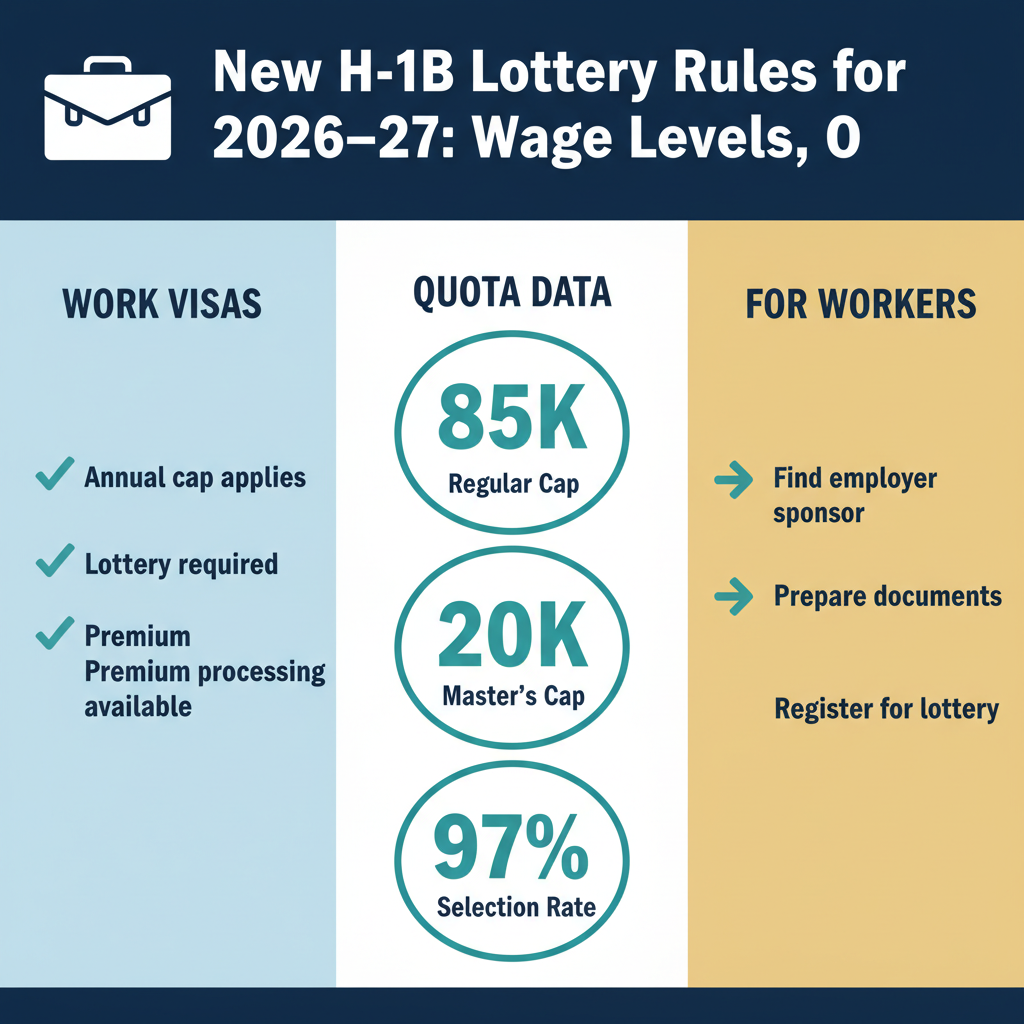
- Annual cap: 65,000 “regular cap” H‑1B visas each year, plus 20,000 extra visas for people with a U.S. master’s or higher degree from a qualifying institution (the “advanced degree cap”).[4][5]
- Why a lottery? Every year, demand far exceeds the 85,000 total slots. USCIS uses a lottery to decide which registrations can move forward to full H‑1B petitions.[4][6]
- Timeline: For FY 2027 (jobs starting October 1, 2026 or later), the online registration window is expected to open in early March 2026 and close in mid‑March 2026.[2][4]
The Biggest Change: Wage‑Weighted H-1B Lottery
Under the old system, every registered H‑1B candidate had one entry in the lottery, no matter the wage.[4] The new rule keeps the cap numbers the same but prioritizes higher‑paid positions by giving them more entries in the selection pool.[3][5][6]
How the Wage‑Weighted System Works
The rule ties lottery entries to the prevailing wage level used for that job and location, based on the U.S. Department of Labor’s four‑tier wage structure.[3][6]
- Level 1 wage (entry level): 1 entry in the lottery
- Level 2 wage: 2 entries in the lottery
- Level 3 wage: 3 entries in the lottery
- Level 4 wage (highest level): 4 entries in the lottery[1][3][4][6]
The system is still ultimately a lottery, but the “pool” is weighted: the more entries you have, the better your statistical chance of selection.[3][6] DHS has stated that the purpose is to prioritize higher‑wage positions and reduce concentration of H‑1Bs in low‑wage roles.[1][3][5][6]
What This Means for Different Workers
In practice, this change:
- Improves odds for workers in higher‑paid roles (often more senior or highly specialized positions) because they get multiple entries.[1][3][4][6]
- Reduces relative odds for workers at entry‑level wages (Level 1), especially recent graduates and junior professionals, who get only one entry.[1][3]
- May encourage employers to offer higher wages or classify roles at higher levels when justified, to improve selection odds.[3][6]
One analysis estimates that under the new rule, a Level 4 beneficiary could see a selection probability around 61%, while a Level 1 beneficiary might see around 15%, illustrating how strong the weighting effect can be.[1]
Fees and Costs: What to Expect
The new rule does not change the cap numbers, but it does affect fees and financial planning.
- H‑1B registration fee: The non‑refundable online registration fee for FY 2027 cap season is $215 per registration.[6]
- Additional $100,000 fee: Certain H‑1B petitions filed for consular processing (rather than change of status within the U.S.) remain subject to a controversial $100,000 fee, which has been upheld for now but is tied to ongoing litigation.[1][6]
These costs are generally the employer’s responsibility, but they affect how many candidates a company is willing to register and under what terms, which indirectly impacts you as the beneficiary.
Timeline: What Happens and When for FY 2027
Here is the expected sequence for the upcoming H‑1B cap season under the new rules.[2][3][4][5][6]
- Now – February 2026: Employers identify candidates, confirm job descriptions, wage levels, and gather information for registration.
- February 27, 2026: New wage‑weighted H‑1B lottery rule becomes effective.[3][5][6]
- Early March 2026: USCIS opens the online H‑1B cap registration period (employers submit registrations listing each beneficiary and wage level).[2][4]
- Mid‑March 2026: Registration window closes.[2][4]
- After registration closes: USCIS runs the wage‑weighted selection and notifies employers which beneficiaries have been selected.[2][4][6]
- Following selection: Employers file full H‑1B petitions (with LCA, forms, and evidence) during the filing window set by USCIS.
- On or after October 1, 2026: Approved H‑1B workers under the FY 2027 cap can begin work, assuming change of status or visa stamping is completed.
What Employers Must Do Under the New Rules
The new system adds steps and strategy for employers—and you can encourage your employer to prepare early.
1. Determine the Correct Wage Level
When registering, employers must now declare the wage level that corresponds to your offered salary, occupation, and job location, using the Department of Labor’s four‑tier system.[3][6]
- The wage level must match the prevailing wage data for your specific occupational code and geographic area.[3][6]
- Level selection must be accurate and defensible; DHS has authority to deny H‑1B petitions if it believes employers manipulated wage levels to improve lottery odds.[1][3][6]
2. Align Job Duties, Requirements, and Wage
The job description, required degree, years of experience, and offered salary must all be consistent with the selected wage level.
- For example, a role demanding significant experience and advanced skills but paid at Level 1 could invite a challenge by USCIS or the Department of Labor.
- Similarly, inflating a level (e.g., Level 4 for a genuinely entry‑level job) may result in closer scrutiny and potential denial.[1][3]
3. Budget for Higher Wages and Fees
Because higher wages increase the chances of selection, employers may:
- Offer more competitive salaries to stay attractive and improve lottery odds.[3][6]
- Limit registrations to candidates whose roles can reasonably be paid at Level 2 or higher.
- Carefully evaluate whether to proceed with petitions that could trigger the $100,000 consular notification fee.[1][6]
What Foreign Workers Can Do to Improve Their Chances
You cannot control everything about the H‑1B process, but you do have meaningful ways to strengthen your position under the new rules.
1. Understand Your Likely Wage Level
While only your employer can formally set the wage level, you can:
- Ask your employer or HR which wage level they expect to use for your role and location.
- Review your job duties and required skills; positions requiring more experience and responsibility may justify higher wage levels.
- Discuss how your experience, certifications, and specialized skills support a higher level classification.
2. Strengthen Your Job Offer
Since higher wages mean better odds, consider:
- Negotiating salary based on market data and your contributions, while remaining realistic and professional.
- Highlighting any specialized skills, niche technologies, or advanced qualifications that justify a higher wage.
- Pursuing additional certifications or training now that can support stronger job descriptions and wage levels by March 2026.
3. Coordinate Early With Your Employer
Do not wait until March 2026. Practical steps to take now include:
- Confirm that your employer is planning to register you for the FY 2027 cap.
- Ensure your passport, academic records, and resume are updated and easy to provide to HR or the company’s immigration counsel.
- If you work for a smaller company or startup, encourage them to consult an immigration attorney to avoid errors and missed deadlines under the new rules.
4. Use the U.S. Advanced Degree Advantage (If You Qualify)
The separate cap of 20,000 for U.S. master’s or higher degree holders still exists.[4][5] If you are finishing a U.S. graduate program:
- Make sure your employer knows your degree completion date.
- Coordinate timing so that you can be counted under the advanced degree cap, which may slightly improve your overall chances of selection.
Special Considerations for Students and Entry‑Level Workers
The new rule may hit new graduates and early‑career workers hardest, because many entry‑level offers align with Level 1 wages.
Challenges
- Level 1 candidates receive only one entry in the lottery, while Level 4 candidates get four.[1][3][6]
- As a result, younger professionals may have a lower chance of selection compared to more senior peers.[1]
Practical Strategies
- Ask whether your role can reasonably be structured at Level 2 based on job complexity, supervision, and minimum requirements.
- Seek roles with more responsibility (and corresponding pay), even within the same company.
- Consider employers in regions or industries that typically pay higher wages for your skill set.
DHS has emphasized that, unlike an earlier rejected proposal, this rule does not completely exclude Level 1 workers; they still have a chance, just at reduced relative odds.[1]
Family Impact: What This Means for Spouses and Children
While the new rule focuses on how workers are selected for H‑1B status, the impact extends to families.
- H‑4 spouses and children: If your H‑1B is selected and approved, your spouse and unmarried children under 21 may qualify for H‑4 status to live in the U.S.
- Work authorization for H‑4 spouses: Certain H‑4 spouses can apply for work authorization if specific conditions are met (for example, where the H‑1B holder is far enough along in the permanent residence process). The new lottery rules do not change those eligibility standards, but they affect whether you get H‑1B status at all.
- Planning for school and finances: Because the odds are now more closely tied to wages, families may want to plan more conservatively (backup immigration options, savings, and schooling plans) until a selection notice is confirmed.
Compliance Risks: Avoiding Problems with the New Lottery System
DHS has made clear it will scrutinize registrations and petitions to prevent abuse of the weighted system.[1][3][6]
- Improper wage inflation: Overstating wage levels or misclassifying positions to gain extra entries can result in denial of petitions and potential penalties.[1][3]
- Inconsistent information: If the wage level on registration does not match the prevailing wage used in the Labor Condition Application (LCA) or the actual salary, USCIS may question the petition.
- Multiple related entities: Where corporate groups file multiple registrations for the same beneficiary, USCIS may assess whether the structure is being used to unfairly inflate chances, in addition to scrutinizing wage levels.
As an employee or candidate, you can protect yourself by ensuring that the offer you accept is genuine, the salary is actually paid, and the job duties match what is described in the petition.
Realistic Expectations and Backup Plans
Even with multiple entries for higher wages, the H‑1B remains a competitive and limited program. It is wise to prepare for both outcomes.
If You Are Selected
- Coordinate closely with your employer to provide all documents needed for the full H‑1B petition filing.
- Monitor USCIS notices and processing times; consider premium processing if available and appropriate.
- If you are abroad, plan early for consular visa interviews and travel logistics.
If You Are Not Selected
Consider alternative options with your immigration attorney, which may include:
- Extending or changing current nonimmigrant status where allowed (for example, F‑1 STEM OPT where applicable).
- Exploring cap‑exempt H‑1B options with qualifying institutions (such as certain universities and nonprofit research organizations).
- Considering other employment‑based visa categories where available.
The new rule increases the importance of planning early and keeping more than one pathway open when possible.
Encouraging Perspective: How to Navigate the New H-1B Landscape
The wage‑weighted H‑1B lottery is a substantial shift, and it naturally creates anxiety—especially for students, entry‑level workers, and families counting on a stable future in the U.S. But it also offers clear, concrete levers you and your employer can use: job structure,


