


Critical Daubert Hearing Approaches in Baby Food Autism Lawsuits
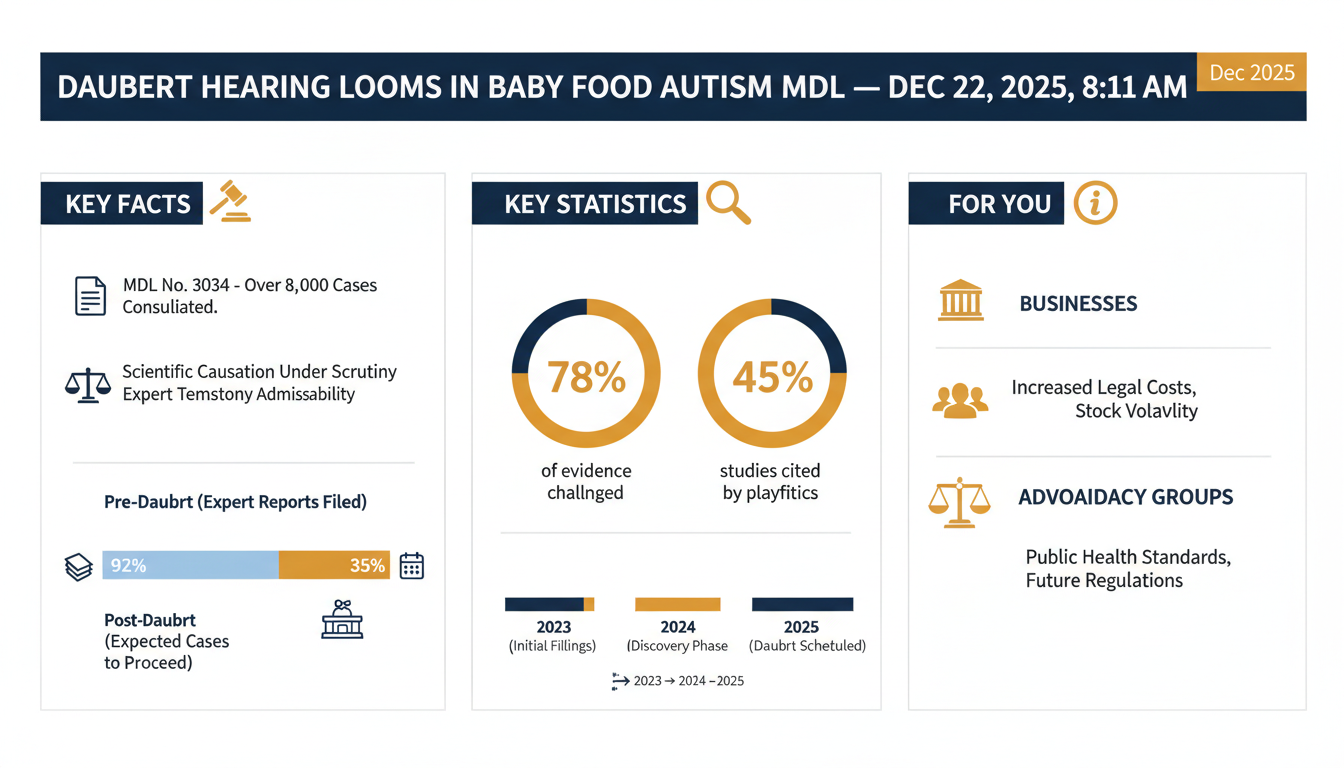
As December 2025 unfolds, a high-stakes Daubert hearing in the federal multidistrict litigation (MDL No. 3101) over baby food contaminated with heavy metals draws national attention. This hearing will determine whether expert witnesses can testify that toxic metals like lead, arsenic, and mercury in products from Gerber, Beech-Nut, and others cause autism spectrum disorder (ASD) and attention deficit hyperactivity disorder (ADHD). A favorable ruling for plaintiffs could unlock trials and pressure manufacturers toward settlements, while exclusion of experts risks dismissing numerous cases.[4]
Background on the Baby Food Litigation Surge
The controversy ignited in 2021 following a U.S. House Oversight Committee report revealing alarming levels of heavy metals in commercial baby foods. Parents nationwide began filing product liability suits, alleging these toxins led to lifelong developmental injuries in their children. By April 2024, the Judicial Panel on Multidistrict Litigation (JPML) centralized cases into MDL 3101 before U.S. District Judge Jennifer L. Corley in the Northern District of California.[4]
- April 2024: JPML forms MDL 3101 for consolidation of federal baby food lawsuits.
- April-June 2024: Initial orders establish discovery deadlines, steering committee, and case management.
- April 2, 2025: Judge Corley denies defendants' motion to dismiss, affirming the lawsuits' validity and allowing litigation to proceed.[4]
Pretrial Order (PTO) #15 further advanced the case, setting plaintiff expert reports due by May 23, 2025, defense reports by June 20, 2025, and general causation discovery completion by August 29, 2025. Crucially, the court limited initial focus to ASD and ADHD claims.[4]
Understanding the Daubert Hearing's Role
Named after the 1993 Supreme Court case Daubert v. Merrell Dow Pharmaceuticals, Inc., 509 U.S. 579, a Daubert hearing evaluates the admissibility of scientific expert testimony under Federal Rule of Evidence 702. Judges act as gatekeepers, ensuring testimony is reliable, relevant, and based on testable methods—not junk science.
In MDL 3101, plaintiffs' experts must demonstrate a causal link between baby food heavy metals and neurodevelopmental disorders. Defendants, including major manufacturers, argue the science is unsettled. The December 2025 hearing—timed amid ongoing discovery—could be decisive: admission bolsters bellwether trials; exclusion guts the MDL.[4]
Legal Implications for Manufacturers, Parents, and Regulators
This development reverberates across product liability law, consumer protection, and public health policy. For defendants, a loss heightens settlement risks, potentially costing billions given the case volume. Manufacturers face renewed scrutiny over supply chains and testing protocols.
Plaintiffs gain momentum from Judge Corley's April 2025 denial of dismissal, signaling judicial recognition of plausible claims. Broader implications include:
- Precedent for Toxic Exposure Cases: Success could expand liability in food contamination suits, influencing cadmium or BPA litigation.
- FDA Oversight Pressure: Despite 2021 congressional pushes, the FDA lacks binding heavy metal limits for baby food, relying on voluntary guidelines.
- Class Action Potential: While MDL focuses individual claims, wins may spawn class certifications for medical monitoring.
Economically, stock watchers note impacts on Gerber (Nestlé) and Beech-Nut, with litigation reserves already mounting.[4]
Scientific Debate at the Core
Plaintiffs cite studies linking early-life heavy metal exposure to neurotoxicity, including elevated ASD/ADHD risks. The CDC reports average lead levels in baby food exceeding safe thresholds. Defendants counter with epidemiological gaps, asserting no definitive causation.[4]
Judge Corley's rulings emphasize rigorous peer-reviewed evidence, aligning with Daubert factors like testability, error rates, and general acceptance.
Actionable Guidance for Affected Families
If your child consumed suspect baby foods (e.g., Gerber Puffs, Beech-Nut stages 1-2) and shows ASD/ADHD symptoms, time-sensitive steps are essential. Statutes of limitations vary by state (typically 2-3 years from diagnosis or discovery).
Immediate Steps for Parents
- Preserve Evidence: Retain product packaging, receipts, medical records, and exposure timelines. Document diagnoses via pediatricians or neurologists.
- Check MDL Inclusion: Visit the MDL 3101 docket (N.D. Cal., Case No. 4:24-md-03101) or consult counsel to assess federal filing eligibility.
- File State Claims: Parallel state court suits may offer faster resolutions; Florida's 4-year limit applies (Fla. Stat. § 95.11(3)(a)).
- Seek Medical Monitoring: Even without causation proof, some jurisdictions award funds for ongoing tests.
Working with Imigrar Law Firm
At Imigrar, our Orlando-based immigration and civil litigation team extends expertise to product liability. Though primarily immigration-focused, we partner with top personal injury specialists for toxic exposure cases. Schedule a free consultation to:
- Evaluate your child's case against MDL timelines.
- Navigate discovery and expert coordination.
- Explore settlements, as Daubert wins often trigger negotiations.
Contact us at (407) 555-1234 or via our secure portal. Early action maximizes recovery for therapies, lost wages, and pain/suffering.
Broader Context: Recent Federal Developments
Baby food suits intersect with December 2025 regulatory shifts. The PFAS Accountability Act (H.R. 6626, S. 3460), introduced December 11, 2025, amends TSCA for medical monitoring in contamination cases—paralleling heavy metals claims. It empowers courts to award monitoring for PFAS victims, potentially inspiring baby food expansions.[1]
Meanwhile, consumer protections evolve: FCC's TCPA order (DA 24-1154) effective January 27, 2025, tightens telemarketing consent, aiding litigation against unscrupulous marketers.[2] Delaware foreclosure safeguards expire January 1, 2025, urging urgency for affected families.[2]
Immigration Overlaps for Affected Families
Many plaintiffs hail from immigrant communities. Imigrar notes DACA and H-1B updates could intersect if parents pursue work visas amid child care burdens. Birthright citizenship debates add uncertainty.[3]
What to Watch Post-Hearing
Monitor Judge Corley's order, expected early 2026. Admission paves bellwethers; exclusion prompts appeals to the Ninth Circuit. Settlements may precede trials, as in Johnson & Johnson talc MDLs.
Stay informed via official dockets and Imigrar updates. This case underscores corporate accountability—empowering families against hidden dangers.
Disclaimer: This article provides general information, not legal advice. Consult an attorney for personalized guidance. Sources verified as of December 2025.[1][4]


