


Overview: What happened
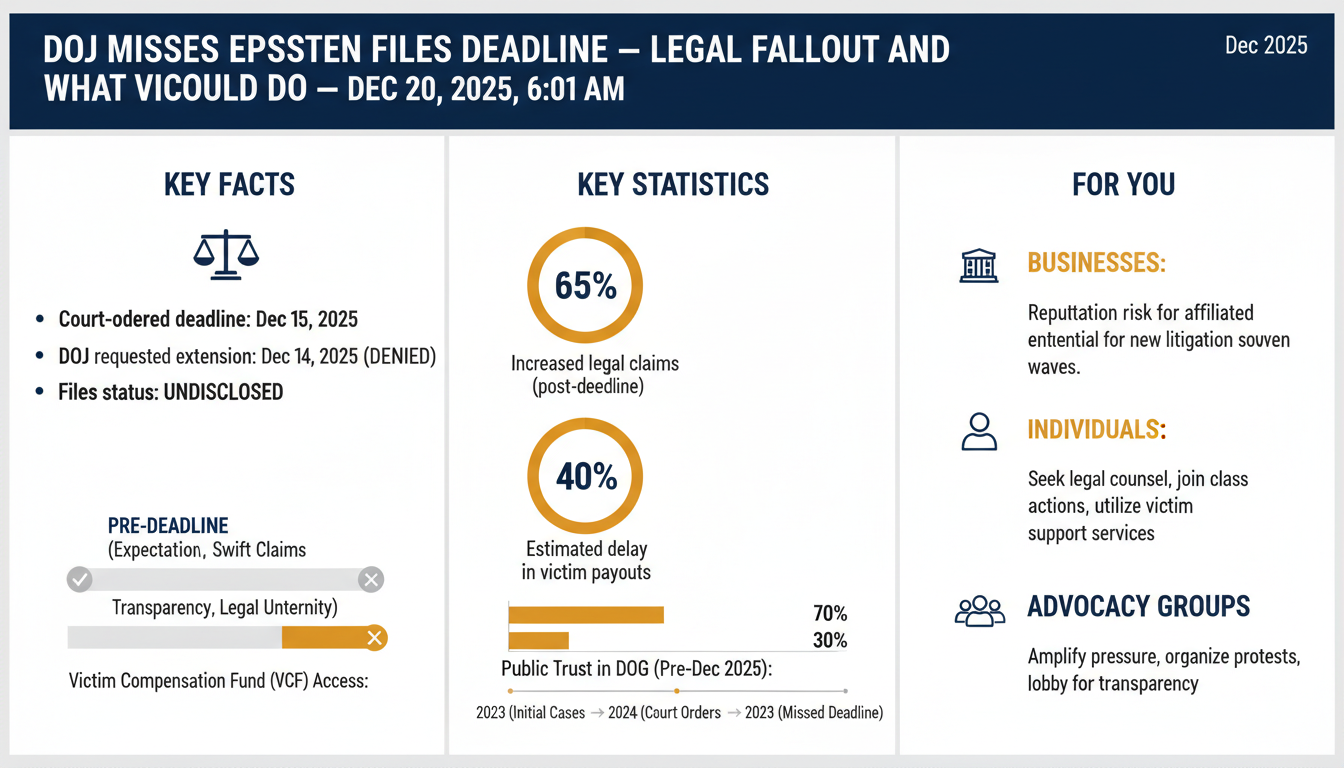
The U.S. Department of Justice failed to meet the statutory deadline to publicly release the full set of unclassified records referred to as the “Epstein files,” prompting immediate criticism from members of Congress, public-interest advocates, and state officials and raising the prospect of civil and criminal enforcement actions against the Executive Branch or individual officials under the new law and other statutes[4][6].
Sources and immediate developments
Congress passed the Epstein Files Transparency Act in November, which required the Attorney General to make public all unclassified records, documents, communications and investigative materials in the possession of the Department of Justice, the FBI, and U.S. Attorneys’ offices relating to the federal investigations of Jeffrey Epstein within 30 days of the law’s enactment; President Trump signed the law on November 19, 2025[4].
On/around the statutory deadline of December 19, 2025, DOJ released an initial trove of documents but several Members of Congress, including Reps. Thomas Massie and Ro Khanna, and Senators such as Jeff Merkley, publicly stated that the release “failed to comply with the law” because it was partial, heavily redacted, or consisted largely of material already in the public domain[4][6].
Democratic and bipartisan statements, media reporting, and state officials (including Oregon Attorney General Rob Bonta in other recent federal-administration actions) indicate coordinated political and legal pressure to compel fuller compliance, and lawmakers have publicly warned of possible contempt, impeachment referrals, or criminal prosecution for willful defiance of the statute[4][6][8].
Legal basis: what the statute requires and potential legal theories of enforcement
Statutory requirement under the Epstein Files Transparency Act
The Epstein Files Transparency Act obligates the Attorney General to publish “all unclassified records, documents, communications and investigative materials” in Department, FBI, and U.S. Attorney possession tied to the federal Epstein investigations within the statutory deadline (30 days after enactment), subject to any lawful and narrowly tailored redactions for legitimately protected information[4].
Possible legal claims and remedies
- Mandamus or declaratory relief: A court could be asked to compel DOJ compliance with the statute by ordering production of withheld, non-classified records if Congress clearly commanded release and the Executive has no lawful basis to withhold them. Mandamus is an extraordinary remedy but is available where a government officer has a nondiscretionary duty to act.[4][8]
- Civil contempt or injunctions: A court could hold officials in contempt if a judicial order compelling release is ignored, or enter an injunction requiring specific disclosure steps and timelines.[8]
- Criminal statutes potentially implicated: Observers and some commentators have flagged statutes criminalizing the willful concealment of records, obstruction of justice, or willful failure to comply with legally required record production; enforcement would depend on proof of intent and prosecutorial decisions, and would be novel and politically complicated.[5]
- Congressional remedies: Congress can use oversight tools — subpoenas, contempt referrals, and in extreme cases impeachment — to enforce statutory compliance; several Members have publicly warned of those options[6][8].
Why DOJ says it did not fully comply
DOJ statements accompanying the initial release and reporting indicate the Department characterized the materials released as the first tranche and asserted the need for careful review and redaction to protect ongoing investigations, privacy interests, classified material, grand jury secrecy, and legitimate law enforcement sensitivities.[4][2]
Those justifications are the kinds of legal claims the Executive typically uses to delay or limit disclosure; their sufficiency under the new statute will likely be the primary legal contention in any litigation or congressional enforcement action[4][8].
Legal implications — what this means
Short-term implications are political and legal pressure on DOJ to produce more complete, less-redacted records quickly; persistent failure risks lawsuits, contempt referrals, and intensified congressional oversight[4][6][8].
Longer-term implications include precedent about the scope of statutory transparency mandates and the limits of Executive discretion to withhold records even when public-interest statutes require disclosure; a court ruling compelling release would strengthen congressional authority to require publication of certain investigatory materials, while a ruling allowing extensive redactions would reinforce Executive latitude to protect investigative equities.[4][8]
For victims and litigants, the scope of released materials affects civil litigation, criminal investigations, and possible restitution or discovery in pending and future cases: fuller files could reveal leads, witnesses, communications, and documentary evidence relevant to civil suits and criminal referrals[4].
Practical consequences for affected parties
- Survivors and civil litigants: More complete files could supply evidence for civil suits (e.g., for trafficking, conspiracy, negligent supervision), support motions for discovery in ongoing cases, or identify previously unknown witnesses and transactions[4].
- Defense and criminal investigations: Prosecutors and defense counsel may use newly released material to assess charges, investigate additional actors, or evaluate disclosure obligations in pending prosecutions; conversely, partial or heavily redacted releases could spur Brady/Giglio arguments seeking unredacted or exculpatory material.[4]
- Media and public oversight: Journalists and oversight groups will comb the records for systemic failures, institutional complicity, or misconduct; further releases may prompt additional investigations and legislative proposals.[4][6]
Actionable guidance — what affected individuals should do now
For survivors and civil plaintiffs
- Preserve and organize any documents, communications, or records you possess that may relate to Epstein or co-conspirators; this preserves evidence for civil claims and helps counsel cross-check newly released files.
- Contact an attorney experienced in human-trafficking, civil sexual-abuse, or complex litigation to evaluate potential claims and how newly released DOJ materials may support litigation or settlement demands.[4]
- If you filed a civil claim and counsel expects additional government-produced materials to aid discovery, discuss motions to compel or judicially enforce disclosure tied to the statute and possible Brady-related needs in criminal matters.
For journalists, researchers, and advocates
- Compile a catalog of released materials and compare them against known public records to identify genuinely new documents; document redactions and missing categories to support FOIA or oversight litigation where appropriate[4].
- Coordinate with legal counsel to issue targeted FOIA requests, document preservation letters, or to support congressional oversight requests and subpoenas.
For members of Congress and state officials
- Consider procedural enforcement options: data requests, subpoenas for unredacted materials, contempt referrals, or coordinated litigation seeking declaratory/judicial relief to compel full compliance[6][8].
- Where appropriate, use legislative tools (hearings, holds on nominations, or budgetary oversight) to press for compliance while evaluating the legal merits of court action under the statute[6].
How litigation or enforcement might proceed
Litigation likely will focus on two central legal questions: (1) whether the statute unambiguously required prompt publication of the specific categories of records at issue, and (2) whether the Executive lawfully narrowed that duty through permissible redactions or non-publication based on recognized privileges (e.g., grand-jury secrecy, classified material, law-enforcement-sensitive information).[4][8]
If plaintiffs or Congress obtain a favorable judicial interpretation that the statute requires broader publication, courts can issue mandamus or injunctive remedies compelling specific disclosures and could hold officials in contempt for noncompliance with court orders.[8]
Criminal prosecution of officials for failing to comply would be unprecedented, would require proof of criminal intent under relevant statutes, and would raise significant separation-of-powers and prosecutorial-discretion questions; commentators note such referrals have been publicly threatened but would be legally and politically complex to pursue[5][6].
Relevant authorities and sources
- Epstein Files Transparency Act — statutory language requiring DOJ release of unclassified records (law signed Nov. 19, 2025) and related legislative history referenced in public reporting[4].
- Initial DOJ release and press coverage about the partial tranche and agency statements regarding review and redaction needs[4][8].
- Public statements by Members of Congress, including Reps. Thomas Massie and Ro Khanna and Senator Jeff Merkley, asserting DOJ noncompliance and threatening enforcement actions[4][6].
- News reporting and analysis discussing possible legal remedies, including mandamus, contempt, and unusual criminal-exposure arguments advanced by commentators and former prosecutors[5][8].
What to watch next
- Congressional response: subpoenas, hearings, holds on nominations, or contempt referrals if DOJ does not produce additional unclassified records quickly[6][8].
- Litigation filed by private parties or congressional committees seeking judicial orders compelling release or clarifying permissible redaction categories[8].
- Additional DOJ releases and whether subsequent tranches materially expand the scope and reduce redactions of the initial documents[4].
- Any formal legal action or criminal referral regarding willful noncompliance — likely to be litigated on separation-of-powers and intent grounds if pursued[5].
Practical checklist for individuals affected
- Document: Keep and organize any personal records or communications related to Epstein or known associates.
- Consult counsel: If you seek civil relief or have relevant information, consult an attorney immediately to assess claims and discovery strategy.
- Monitor releases: Track DOJ publications and major media summaries to identify documents relevant to your case.
- Preserve evidence: Avoid deleting communications, and issue preservation notices where appropriate through counsel.
- Engage oversight: If you are an advocate or policymaker, coordinate FOIA, congressional, or state-law enforcement strategies to press for full disclosure.
Limitations and notes on uncertainty
This article reports on contemporaneous developments: initial DOJ disclosures and public statements by lawmakers and commentators alleging noncompliance with the Epstein Files Transparency Act[4][6][8]. The specific scope of withheld material, the Government’s legal justifications for redactions, and whether courts or Congress will ultimately compel fuller release remain unresolved; outcomes will depend on forthcoming litigation, congressional actions, and any additional DOJ disclosures[4][8].
Key citations
Primary reporting and statements informing this article include: media coverage of DOJ’s initial release and lawmakers��� reactions[4][8], public statements by Senator Merkley and others alleging statutory noncompliance[6], and analysis of potential enforcement avenues by commentators and former prosecutors[5].
If you are a survivor, potential plaintiff, or counsel seeking to act on these developments and would like help assessing possible claims, drafting preservation requests, or preparing FOIA/administrative or litigation strategies, contact an attorney experienced in civil sexual abuse, trafficking, and complex federal litigation to discuss next steps.


