


Illinois HB 3645 Takes Effect Jan 1: Boosts Overdose Tracking via ODMAP
Published by Imigrar Law Firm – Your Orlando Immigration Experts
What You Need to Know About Illinois' New Overdose Reporting Law
Effective January 1, 2026, Illinois House Bill 3645 represents a pivotal update in public health policy, authorizing the Illinois Department of Public Health (IDPH) to transmit limited overdose information from first responders to the Overdose Detection Mapping Application Program (ODMAP).[1] Sponsored by Reps. Michael Kelly and Matt Hanson, and Sen. Laura Fine, this law addresses the escalating opioid crisis by enabling real-time data sharing to track and respond to overdose events more effectively.[1]
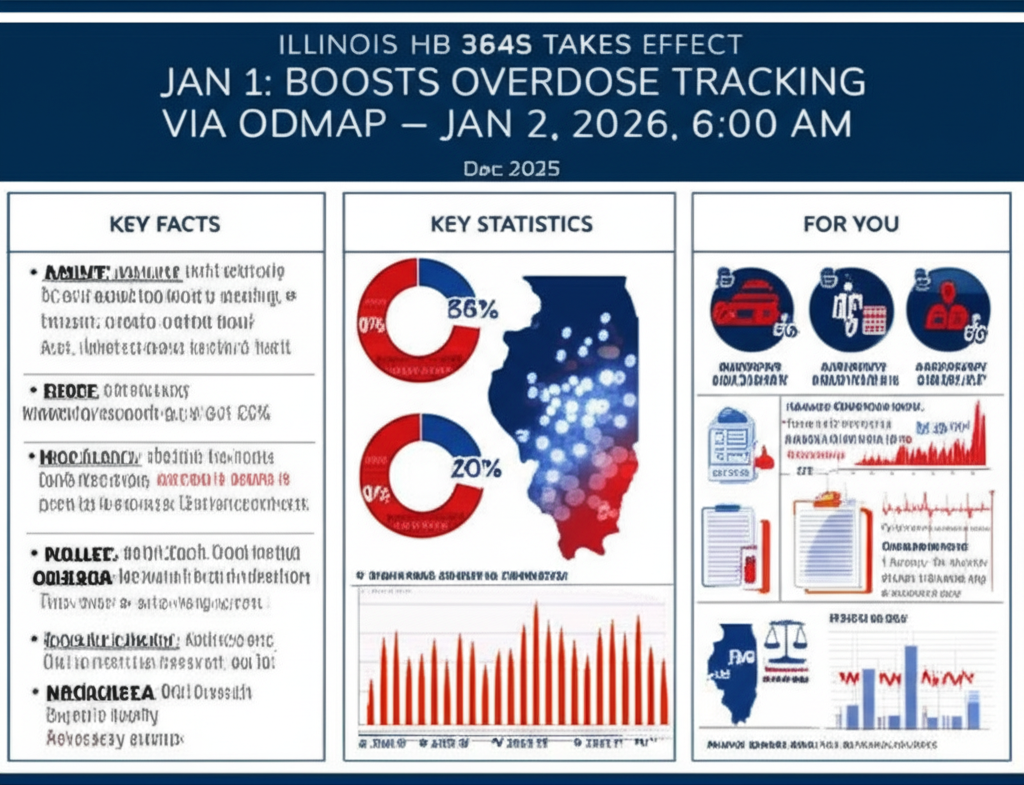
ODMAP, a national tool used by public health officials, aggregates anonymized data to map overdose incidents, facilitating resource allocation and prevention strategies. Under HB 3645, data from first responders covered by the Emergency Medical Services (EMS) Systems Act—such as paramedics and EMTs—will flow directly to IDPH for submission to ODMAP. This streamlined process promises timely interventions, better resource use, and stronger overdose prevention across the state.[1]
Legal Background and Path to Enactment
HB 3645 emerged from bipartisan efforts in the Illinois General Assembly during the 2025 legislative session. Governor JB Pritzker signed the bill into law as part of a broader package of public health measures taking effect in 2026. IDPH Director Dr. Sameer Vohra highlighted its importance, stating, “The New Year offers a critical opportunity to advance public health... through new laws... improving overdose reporting.”[1]
Prior to this, overdose data reporting in Illinois relied on fragmented systems, often delaying public health responses. The EMS Systems Act (210 ILCS 50/) previously governed first responder protocols but lacked explicit provisions for ODMAP integration. HB 3645 amends this by adding targeted data transmission authority, balancing privacy protections with public safety needs.[1]
This law aligns with federal initiatives like the Substance Use-Disorder Prevention that Promotes Opioid Recovery and Treatment (SUPPORT) for Patients and Communities Act (Pub. L. 115-271, 2018), which encourages overdose data mapping nationwide. Illinois now joins states leveraging ODMAP to combat the opioid epidemic, where over 100,000 overdose deaths occurred nationally in recent years per CDC data.
Key Legal Implications for Stakeholders
For Healthcare Providers and EMS Personnel: First responders must now report limited overdose details—such as location, time, and basic incident type—to IDPH. This is not a new documentation burden but a redirection of existing EMS data to ODMAP. Non-compliance could trigger oversight under the EMS Systems Act, potentially leading to licensure reviews by the Illinois Department of Public Health.[1]
Privacy and Data Security: The law specifies "limited information," ensuring compliance with HIPAA (Health Insurance Portability and Accountability Act, 42 U.S.C. § 1320d et seq.) and Illinois' Personal Information Protection Act (815 ILCS 530/). Data is de-identified before ODMAP submission, minimizing breach risks. Providers should update EMS protocols to include ODMAP flagging by Q1 2026.
Public Health Agencies: IDPH gains enhanced analytics, enabling hotspot identification and naloxone (Narcan) distribution. This could influence funding allocations under Illinois' Opioid Remediation Trust Fund, established via the Opioid Crisis Relief Act (410 ILCS 85/).
Broader Impacts: While focused on public health, implications extend to civil litigation. Improved data may strengthen cases under wrongful death statutes (740 ILCS 180/) where overdose foreseeability is alleged, or support negligence claims against non-compliant facilities.
Comparison with Other 2026 Public Health Laws in Illinois
| Law | Sponsor | Key Provision | Effective Date |
|---|---|---|---|
| HB 3645 | Reps. Kelly, Hanson; Sen. Fine | EMS overdose data to ODMAP | Jan 1, 2026 |
| SB 119 | Sen. Villa; Rep. Moeller | Mandatory prenatal syphilis testing (1st exam & 3rd trimester) | Jan 1, 2026 |
HB 3645 complements SB 119, which mandates syphilis screening for pregnant patients to combat maternal health disparities.[1] Together, these laws underscore Illinois' 2026 focus on preventable crises.
Actionable Guidance: Steps for Affected Individuals and Businesses
If you are an Illinois resident, healthcare provider, or business with EMS ties, take these steps to comply and leverage HB 3645:
- Review Protocols Immediately: EMS agencies and hospitals should audit reporting workflows against HB 3645 text (Public Act 104-XXXX, available via Illinois General Assembly website). Integrate ODMAP submission by January 15, 2026.
- Train Staff: Conduct HIPAA-compliant training on data limits. Use IDPH resources for free webinars expected in Q1 2026.[1]
- Monitor ODMAP Dashboards: Public health entities can access real-time maps at odmap.org to inform community programs. Individuals seeking naloxone: Visit local pharmacies under Illinois' standing order (200 ILCS 654/).
- Legal Consultation: If facing compliance issues or litigation, consult counsel familiar with EMS regulations. For immigration-impacted families (e.g., mixed-status households in opioid-affected areas), explore how enhanced services aid family stability.
- Report Concerns: File grievances with IDPH at dph.illinois.gov or call 217-785-9933 if data mishandling occurs.
- Stay Updated: Subscribe to IDPH alerts for implementation rules, anticipated by March 2026.
Businesses in pharmaceuticals or recovery services should align marketing with ODMAP insights for targeted outreach, ensuring FCRA (Fair Credit Reporting Act) compliance if using data commercially.
Why This Matters in the National Context
Nationwide, 19 states enacted minimum wage hikes on January 1, 2026, alongside diverse reforms like Texas restrictions on gender-affirming care and programs for incarcerated mothers.[2] Illinois' HB 3645 stands out for its data-driven approach, potentially serving as a model. As opioid deaths persist—projected at 80,000+ annually—the law bolsters multisector responses.
For immigrant communities in Illinois, often overrepresented in high-risk areas, this enhances access to prevention amid barriers like language or status fears. Imigrar Law Firm advises clients: Stable health access supports immigration petitions (e.g., I-601A waivers tied to rehabilitation evidence).
Potential Challenges and Future Outlook
Implementation hurdles include rural EMS tech gaps and data standardization. IDPH commits to partnerships for "measurable improvements."[1] Expect rulemaking under the Illinois Administrative Procedure Act (5 ILCS 100/) by mid-2026.
Advocates may push expansions, like mandating hospital data. Track via LegisScan for amendments.
Contact Imigrar for Expert Guidance
At Imigrar Law Firm in Orlando, Florida, we specialize in immigration law but monitor intersecting public health policies nationwide. HB 3645 exemplifies how state laws influence family and community stability—key for visa renewals or adjustments. Schedule a consultation at imigrar.com or call (407) 955-3255 to discuss your case.
Disclaimer: This article provides general information, not legal advice. Consult a licensed attorney for personalized guidance. Sources verified as of January 2, 2026.


