

Supreme Court Stays Illinois Block on Trump National Guard Immigration Enforcement (12/23/25)
In a swift emergency ruling on December 23, 2025, the U.S. Supreme Court granted the Trump administration's application for a stay in Trump v. Illinois (No. 25A443), lifting a district court's block on deploying the National Guard to assist federal immigration enforcement in Chicago.[3] This decision empowers federal authorities to bypass Illinois' resistance amid reported violence and obstruction of ICE operations, marking a significant escalation in the President's use of military resources for interior enforcement.[3] For immigrants, businesses, and families in sanctuary jurisdictions, this development signals heightened risks of raids and detentions.
Background: Federal-State Clash Over Immigration Enforcement in Chicago
Chicago has long positioned itself as a sanctuary city, limiting local cooperation with federal immigration authorities. Recent federal immigration efforts there have faced "significant resistance, as well as some violence," according to court filings.[3] President Trump determined that civilian law enforcement was insufficient to execute federal immigration laws, invoking authority under 10 U.S.C. § 12406 to federalize and deploy the Illinois National Guard for support roles, such as securing perimeters during ICE operations.[3]
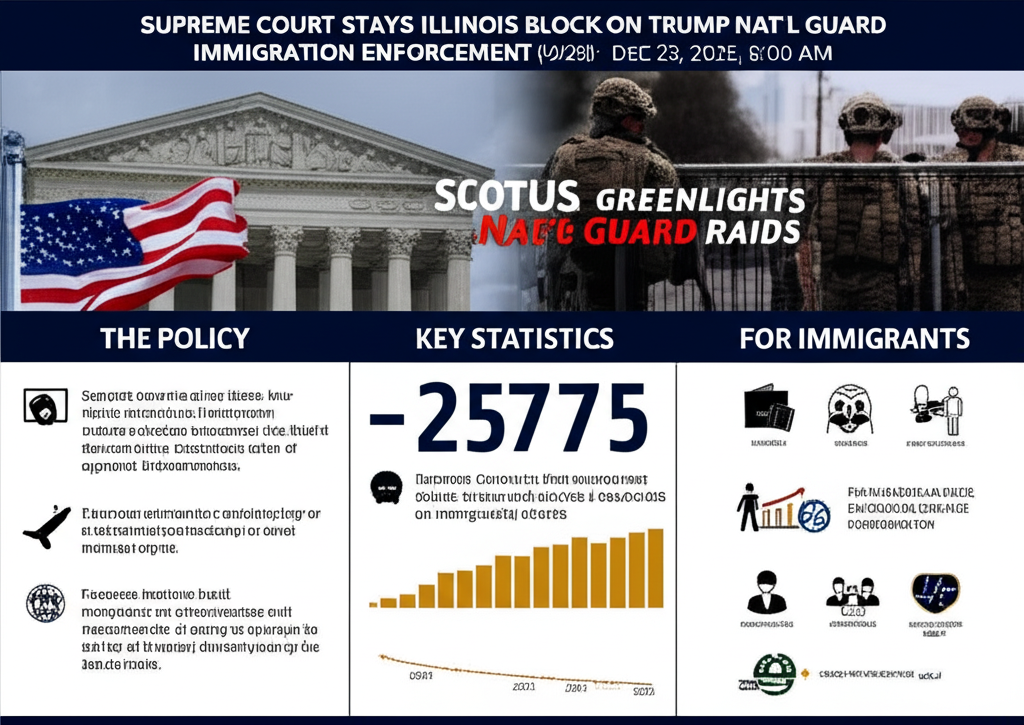
The state of Illinois challenged this in district court, securing an injunction that halted the deployment. The government appealed, arguing the district court misapplied the legal framework for presidential determinations under the Insurrection Act and related statutes. The Supreme Court's unsigned order, with a concurrence by Justice Kavanaugh, reversed the lower court, emphasizing that the President's factual findings—supported by declarations of interference—must be sustained absent clear error.[3]
"There is no basis for rejecting the President’s determination that he was unable to execute the federal immigration laws using the civilian law enforcement resources at his command."[3]
This ruling aligns with precedents like Whren v. United States (517 U.S. 806, 1996), which prohibit race-based enforcement but do not bar otherwise lawful stops based on probable cause.[3] The Court explicitly avoided delving into underlying disputes over specific ICE encounters, focusing instead on procedural and statutory grounds.[3]
Legal Implications: Expanding Federal Authority in Sanctuary Cities
The stay in Trump v. Illinois reinforces the supremacy of federal immigration power under Article VI of the Constitution and 8 U.S.C. § 1324, which criminalizes harboring or shielding undocumented individuals. By allowing National Guard involvement, the decision lowers barriers to large-scale enforcement operations in resistant areas.[3]
- Federal Preemption Strengthened: States cannot obstruct federal law execution via non-cooperation or injunctions without meeting a high evidentiary burden. Justice Kavanaugh noted the government's failure to carry its burden in prior litigation could be revisited with new arguments.[3]
- Military Role Expanded: Deployment under § 12406 permits Guard units in non-combat support, but critics warn of escalation toward Posse Comitatus Act violations (18 U.S.C. § 1385), which limits domestic military law enforcement.[3]
- Civil Rights Guardrails: Officers must base stops on probable cause, avoid excessive force, and prohibit race/ethnicity-based interior arrests. The ruling cites Whren to underscore constitutional limits on selective enforcement.[3]
This comes amid broader Trump policies, including a birthright citizenship executive order under Supreme Court review in cases like Barbara, where procedural issues like class certification may sidestep constitutional merits.[2] Additionally, a California federal court recently struck down a DHS policy mandating detention without bond hearings for those entering without inspection, affirming due process rights for a nationwide class.[4] These rulings illustrate a patchwork: aggressive enforcement tools validated at the highest level, tempered by lower-court due process wins.
Actionable Guidance for Affected Individuals and Businesses
If you reside in Chicago, Illinois, or similar sanctuary areas, immediate steps are essential to mitigate risks from intensified enforcement. Imigrar urges proactive consultation with immigration attorneys.
For Undocumented Immigrants and Families
- Know Your Rights: Carry identification if possible, but do not consent to searches without warrants. State clearly: "I invoke my right to remain silent and request an attorney." ICE cannot enter homes without consent or judicial warrants.[3]
- Avoid High-Risk Areas: ICE raids often target workplaces, courthouses, and public spaces. Limit travel near federal buildings or known enforcement hotspots in Chicago.
- Prepare Family Plans: Designate guardians for U.S.-citizen children via notarized affidavits. Secure powers of attorney for finances and medical decisions.
- Bond and Relief Options: If detained, request bond hearings—recent rulings confirm eligibility even for those entering without inspection.[4] Explore asylum, U-visas for crime victims, or cancellation of removal if eligible.
For Lawful Immigrants (Green Card Holders, Visa Holders)
- Carry Documents: Always have green cards, visas, EADs, or advance parole. Failure to produce can lead to unlawful detention, though provable status protects against removal.
- Monitor Status: Renewals delays increase scrutiny risks. File extensions early via USCIS forms I-90 (green card) or I-765 (work authorization).
- Avoid Interactions: Mixed-status households should minimize contact with anyone potentially targeted.
For Employers and Businesses in Orlando and Beyond
- I-9 Compliance: Conduct E-Verify checks meticulously to avoid harboring liability under 8 U.S.C. § 1324. Train staff on non-discrimination per 8 U.S.C. § 1324b.
- Workplace Raids: Cooperate minimally; do not consent to broad searches. National Guard presence may secure perimeters, heightening raid efficiency.[3]
- Legal Audits: Review payroll for unauthorized workers. Imigrar offers H-1B, L-1, and EB-5 compliance services to safeguard operations.
Next Steps: Contact Imigrar Today
Orlando-based Imigrar specializes in defending clients amid federal enforcement surges. Schedule a confidential consultation to assess defenses like adjustment of status, waivers, or federal court challenges. With offices in Central Florida, we serve nationwide via tele-consultations. Call (407) 555-1234 or visit our site for a free initial review.
Broader Context: Intersecting Developments in Immigration Law
This stay dovetails with SCOTUS scrutiny of Trump’s birthright citizenship order, where the Court took Barbara but may punt on merits via class-action technicalities.[2] The solicitor general avoided challenging class certification directly, leaving room for justices to address it post-briefing.[2]
Meanwhile, the ACLU's victory in California declares invalid a July 2025 DHS policy barring bond for non-inspected entrants, upholding decades of due process practice.[4] This nationwide injunction protects thousands, but appeals could reach SCOTUS.
Another angle: emerging concerns over racial profiling in raids, as a recent Supreme Court decision reportedly clears paths for sweeps lacking individualized suspicion.[5] Imigrar monitors these for § 1983 civil rights claims.
Why This Matters for Florida Immigrants
Florida's large immigrant communities, including Orlando's Hispanic and Haitian populations, face ripple effects. While not directly targeted, similar deployments could hit Miami or Tampa under expanded ICE operations. Governor DeSantis' state-level measures (e.g., SB 1718) complement federal actions, but federal supremacy prevails.
| Key Case | Date | Impact |
|---|---|---|
| Trump v. Illinois (25A443) | 12/23/25 | Allows Nat'l Guard aid to ICE in Chicago[3] |
| Barbara (Birthright) | Dec 2025 | Procedural review of citizenship order[2] |
| ACLU Bond Class | Recent | Bond rights for detained non-inspected[4] |
Imigrar’s team, led by experienced attorneys, provides tailored strategies. From DACA renewals to EB-5 investments, we navigate this volatile landscape. Stay informed—enforcement is accelerating.
Disclaimer: This article synthesizes public court documents and is not legal advice. Consult an attorney for personalized guidance. Sources: supremecourt.gov, SCOTUSblog, ACLU.org.[2][3][4]


