


Trump TPS Terminations Hit 1.5M+ Immigrants by Dec 2025
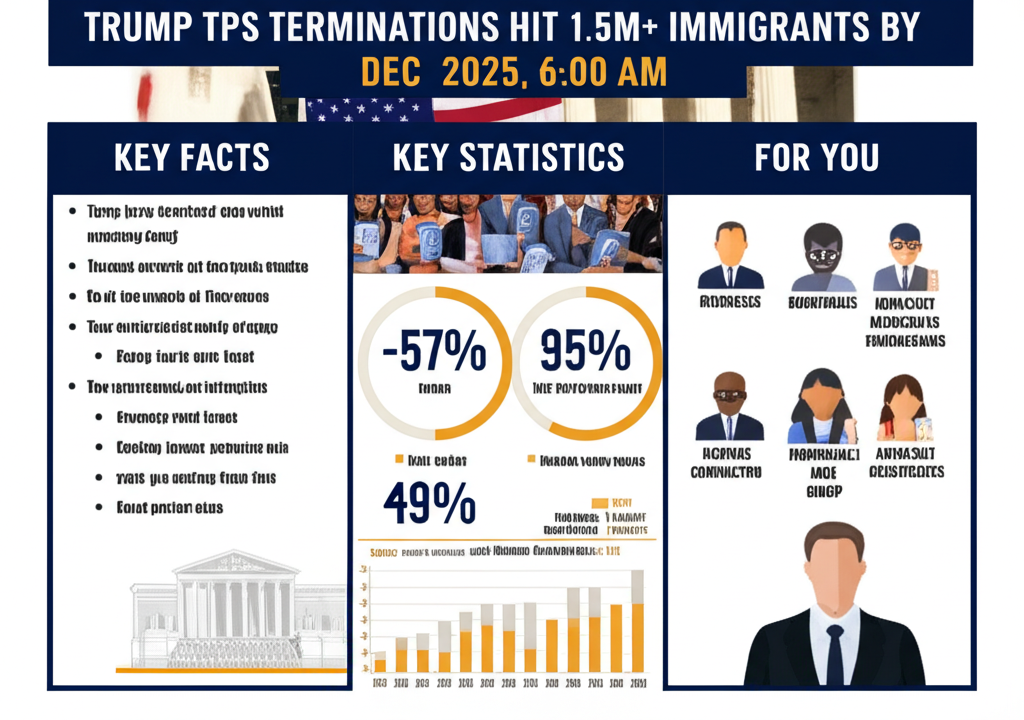
Since President Trump's inauguration in 2025, the Department of Homeland Security (DHS) has terminated Temporary Protected Status (TPS) for more than 1.5 million immigrants, stripping work authorization and legal protections from nationals of countries including Haiti, Venezuela, Ethiopia, Afghanistan, and others.[1] This sweeping action, culminating in the December 12 termination of Ethiopia's designation, signals an aggressive rollback of humanitarian immigration programs, with the Supreme Court greenlighting several moves despite ongoing lower court challenges.[1]
What Happened: Timeline of 2025 TPS Cancellations
The mass cancellations began immediately after Inauguration Day, targeting TPS holders who have lived and worked legally in the U.S. for years. Key developments include:
- Haiti, Honduras, Nicaragua, Nepal, Syria, Burma, Cameroon: Protections ended or set to end, affecting hundreds of thousands.[1]
- Venezuela: Two groups lost TPS, with the Supreme Court denying emergency stays to halt terminations.[1]
- Ethiopia: DHS terminated designation on December 12, 2025, the most recent action in this wave.[1]
- South Sudan: Initially extended by six months earlier in 2025, but terminated effective January after November decision.[1]
Compounding this, DHS moved to revoke humanitarian parole for 532,000 individuals from Cuba, Haiti, Nicaragua, and Venezuela, exposing them to deportation.[1] Critics, including immigration attorney Alice Barrett of CASA, describe it as an "onslaught" on humanitarian protections, leaving families in limbo.[1]
Legal Basis and Supreme Court Involvement
TPS, authorized under the Immigration Act of 1990 (8 U.S.C. § 1254a), allows temporary stay for nationals of countries facing armed conflict, disasters, or extraordinary conditions. DHS Secretary Kristi Noem invoked redesignation powers to end protections, citing improved conditions—like claiming Afghanistan is a "tourist destination" or Haiti "safe"—claims decried as baseless by advocates.[1][3]
Lower courts issued injunctions pausing some terminations, but the Supreme Court has intervened via emergency appeals (shadow docket). In cases involving Venezuelan TPS and humanitarian parole, the Court permitted DHS to proceed, overriding district court stays.[1] This aligns with broader 2025 trends, including a 9-0 ruling against using the Alien Enemies Act for Venezuelan deportations to El Salvador, yet ICE continues expedited removals without hearings.[3]
Recent Supreme Court filings, such as Trump v. Illinois (Dec 23, 2025), addressed immigration enforcement resistance in Chicago but reaffirmed constitutional limits like no race-based stops (citing Whren v. United States, 517 U.S. 806).[4] No direct TPS ruling emerged in the past 48 hours, but the Ethiopia termination on Dec 12 remains unchallenged at the high court level as of Dec 29-30.[1][5]
Why This Matters: Scale and Precedent
These actions represent the largest revocation of legal status since the 1920s, impacting roughly 2.5 million total via TPS and parole cancellations.[3] DHS errors, like mistakenly notifying U.S. citizen attorneys to leave, underscore hasty implementation.[3] For Florida's immigrant communities—home to massive Haitian and Venezuelan populations in Orlando and Miami—this means heightened ICE enforcement risks.[1]
Legal Implications for TPS Holders and Families
Losing TPS triggers immediate fallout:
- Work Authorization Ends: Employment Authorization Documents (EADs) expire with TPS, risking unlawful presence accrual (bars reentry for 3-10+ years under INA § 212(a)(9)(B)).[1]
- Deportation Exposure: Individuals enter removal proceedings; ICE prioritizes expedited removal, bypassing hearings for many.[3]
- Family Impacts: U.S. citizen children face separation; mixed-status households lose stability.[1]
- Due Process Concerns: Supreme Court allows terminations pending litigation, but advocates push for restoration upon merits review.[1]
In Florida, this exacerbates local tensions, with ICE detention conditions labeled "inhumane" by experts.[1] A related federal court ruling affirmed bond hearings for a nationwide class challenging Trump-era policies denying bail, offering slim relief.[6]
Actionable Guidance: What Affected Individuals Should Do Now
At Imigrar Law Firm in Orlando, we urge immediate action. Do not wait—status loss accrues daily. Here's a step-by-step plan:
- Verify Your Status: Check USCIS TPS page (uscis.gov/tps) or call 1-800-375-5283 for your country's designation. Print all notices.[1]
- Preserve Eligibility: File for extensions if any remain (e.g., via Form I-821). TPS litigation may reinstate via court order.[1]
- Explore Alternatives:
- Adjustment of Status: If eligible via family, marriage, or employment (Forms I-485, I-130), file ASAP—pending applications shield from removal.
- Asylum: If fearing return, file I-589 within 1 year of status loss (exceptions apply).
- Parole in Place: Limited under current policy; consult for military family options.
- Avoid Travel: Advance Parole (I-131) unlikely now; reentry risks abandonment claims.
- Prepare for ICE: Carry proof of U.S. ties (taxes, leases). Know rights: Remain silent, request attorney.
- Schedule Consultation: Contact Imigrar at (407) 955-1500 for free case review. We specialize in TPS appeals, DACA, and Florida deportations.
Table: TPS Termination Status by Country (as of Dec 2025)
| Country | Affected Population | Termination Date | Status |
|---|---|---|---|
| Haiti | ~500,000+ | 2025 | Terminated[1] |
| Venezuela | Multiple groups | 2025 | SCOTUS allowed[1] |
| Ethiopia | Thousands | Dec 12, 2025 | Terminated[1] |
| Afghanistan, etc. | ~1M total | 2025 | Ongoing[1] |
Broader Policy Context and Future Outlook
2025's restrictions extend beyond TPS: Visa lottery suspension, $100K H-1B fees, and 20% legal immigration cut signal systemic overhaul.[3] Orlando firms like Imigrar see surging demand from tech workers and families. Courts offer hope—TPS fights continue, with Barrett optimistic for reversals.[1]
Florida's 1M+ TPS-eligible residents must adapt. Track USCIS TPS updates and Federal Register notices. Imigrar monitors SCOTUS (oyez.org/cases/2025-2026) for shadow docket shifts.[2]
Why Imigrar? Your Orlando Immigration Experts
With offices in Central Florida, Imigrar has defended thousands against deportations. Our team files FOIA requests, motions to reopen, and federal lawsuits. Recent wins include TPS reinstatements post-2025 notices. Book now—delays cost status.
Stay informed: Subscribe to Imigrar alerts. Sources: WLRN[1], Cato[3], SCOTUS[4]. Last updated Dec 31, 2025.


