

The 11th Circuit's December 16 Decision: Clearing the Path for CTA Enforcement
On December 16, 2025, the 11th Circuit Court of Appeals issued a significant ruling that removed a substantial legal obstacle to the enforcement of the Corporate Transparency Act (CTA). The court reversed a prior district court decision that had previously enjoined the federal government from enforcing this controversial beneficial ownership reporting requirement. This development marks a critical turning point in the ongoing legal saga surrounding the CTA, which has experienced considerable turbulence since its initial enactment in 2021.
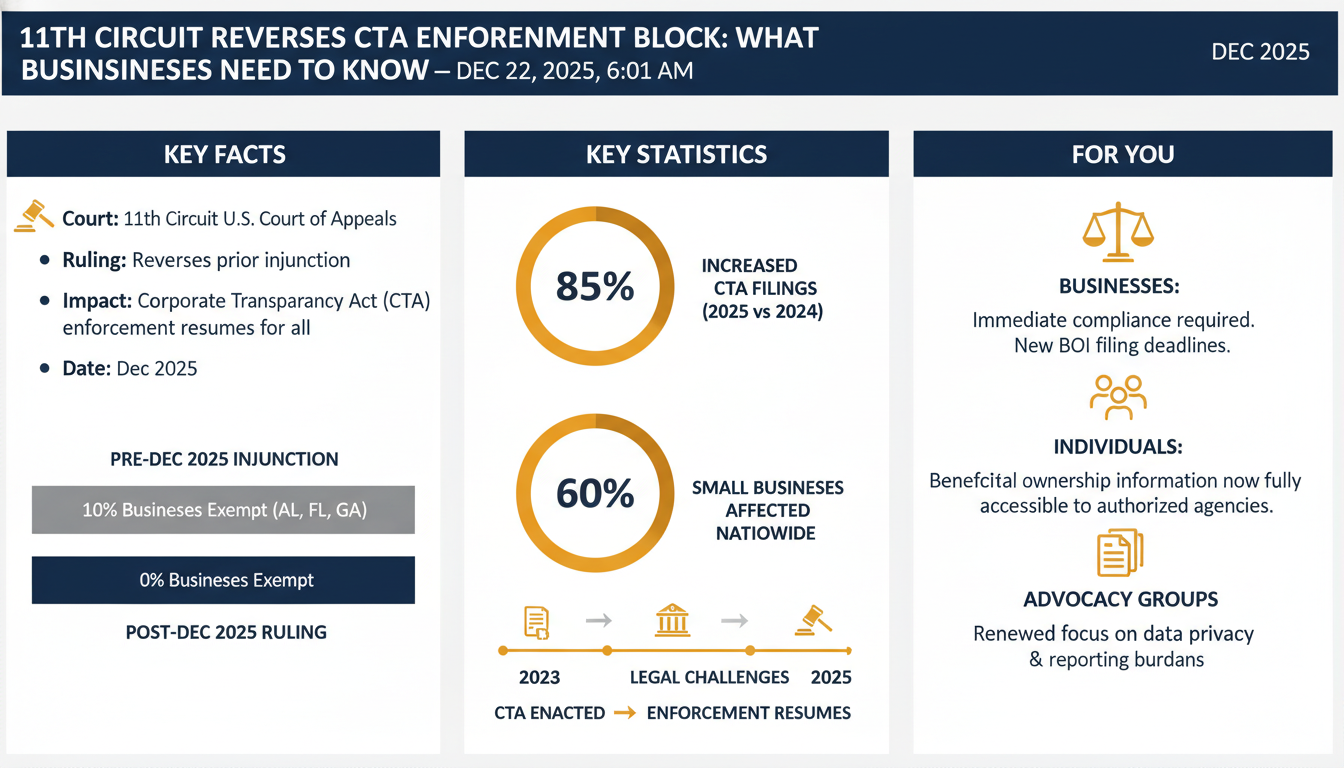
The reversal eliminates what had been a concrete legal impediment to federal enforcement efforts. However, the practical implications for most U.S. businesses remain limited due to interim rules issued by FinCEN (Financial Crimes Enforcement Network), the Treasury Department agency responsible for administering the CTA. Understanding both the legal development and its practical consequences is essential for business owners, corporate compliance officers, and legal professionals navigating this complex regulatory landscape.
Background: The Turbulent History of the Corporate Transparency Act
Initial Enactment and Implementation Challenges
The Corporate Transparency Act, initially enacted in 2021, established a federal requirement for certain entities to report beneficial ownership information to FinCEN. The law's stated purpose is to combat money laundering, terrorist financing, and other financial crimes by increasing transparency regarding who actually owns and controls business entities.
The CTA originally established three sets of staggered reporting due dates. Some entities began reporting obligations in 2024, while many others faced filing requirements beginning at the start of 2025. This phased approach was designed to allow businesses time to gather the necessary information and establish compliance procedures.
The Litigation Roller Coaster
The CTA's implementation has been characterized by significant legal uncertainty. Multiple lawsuits challenged the constitutionality and authority of the CTA, resulting in preliminary injunctions that temporarily halted enforcement efforts. This litigation created substantial confusion among the business community regarding compliance obligations.
In the immediate aftermath of initial litigation victories against the government, FinCEN announced it would cease enforcement of the CTA. However, when a second case's pause was lifted, FinCEN restored the filing obligation effective March 21, 2025. This on-again, off-again enforcement pattern left many businesses uncertain about their actual compliance responsibilities.
The Interim Rules and De Facto Exemption
Recognizing the uncertainty surrounding the CTA, FinCEN announced it would not enforce the statute until it issued interim final rules. When those interim rules were released, they fundamentally altered the practical landscape: the rules removed all beneficial ownership reporting obligations under the CTA for U.S. companies and individuals. This administrative action effectively exempted the vast majority of American businesses from the reporting requirement, even though the statute itself remained on the books.
The December 16, 2025 11th Circuit Ruling: What Changed and What Didn't
The Legal Victory and Its Significance
The 11th Circuit's December 16 decision represents a legal victory for the federal government. By reversing the prior district court injunction, the appellate court removed a concrete legal impediment to CTA enforcement. This means the government is no longer bound by a judicial order prohibiting it from enforcing the statute.
From a constitutional and administrative law perspective, this ruling is significant. It suggests that at least one federal appellate court believes the CTA's requirements and FinCEN's authority to enforce them are legally sound. The decision provides the government with clearer legal footing to pursue enforcement actions if it chooses to do so.
Limited Practical Impact
Despite the legal significance of the 11th Circuit's decision, its practical impact on most businesses remains minimal. The interim rules issued by FinCEN continue to exempt U.S. companies and individuals from beneficial ownership reporting obligations. This means that even with the legal impediment removed, FinCEN's current administrative position is to not require most American businesses to file beneficial ownership information.
The distinction between legal authority and practical enforcement is crucial here. The 11th Circuit's ruling clarifies that the government has the legal authority to enforce the CTA, but it does not change FinCEN's current interim rules that suspend reporting obligations for U.S. entities. Until FinCEN issues new final rules that reimpose reporting requirements, the practical compliance landscape remains largely unchanged for most businesses.
What This Means for Your Business: Practical Implications
Current Compliance Status
If your business is a U.S. company or you are a U.S. individual with a beneficial ownership interest in a business entity, you are currently not required to file beneficial ownership information with FinCEN under the interim rules. This exemption applies regardless of the 11th Circuit's legal ruling, as long as the interim rules remain in effect.
However, the legal landscape is shifting. The removal of the judicial impediment to enforcement suggests that changes may be forthcoming. Businesses should not assume that the current interim rules will remain in place indefinitely.
Foreign-Owned Entities and Continuing Obligations
It is important to note that the interim rules' exemption applies specifically to U.S. companies and individuals. Foreign entities and individuals may still have reporting obligations under the CTA. If your business involves foreign ownership or investment, you should review your specific situation with legal counsel to determine whether beneficial ownership reporting requirements apply.
Monitoring for Regulatory Changes
The 11th Circuit's decision and the removal of the legal impediment to enforcement suggest that regulatory changes may be forthcoming. The government now has clear legal authority to enforce the CTA, and FinCEN may issue new final rules that reimpose reporting requirements on U.S. entities.
Business owners and compliance officers should monitor announcements from FinCEN and Treasury regarding any proposed or final rules changes. The Federal Register is the official source for such announcements, and subscribing to regulatory updates from FinCEN is advisable for businesses that want to stay informed.
The Broader Context: Why This Matters Beyond 2025
Regulatory Uncertainty and Business Planning
The CTA situation exemplifies a broader challenge in the current regulatory environment: legal uncertainty can complicate business planning and compliance strategy. The back-and-forth nature of CTA enforcement—from litigation victories against the government, to enforcement pauses, to interim rules exemptions, to appellate reversals—demonstrates how quickly the regulatory landscape can shift.
For businesses, this underscores the importance of maintaining flexibility in compliance programs and staying informed about regulatory developments. What is not required today may become required tomorrow, and what was once prohibited may become permissible.
The Intersection of Law and Administration
The 11th Circuit's decision also highlights an important principle in administrative law: the distinction between legal authority and practical policy. A court may determine that an agency has legal authority to enforce a statute, but the agency may choose not to exercise that authority fully. FinCEN's interim rules represent an administrative choice to limit enforcement, even though the legal authority to enforce more broadly may exist.
This distinction is important for understanding how regulatory systems actually function. Legal authority and practical compliance requirements are not always aligned, and businesses must monitor both the law and actual enforcement practices.
Actionable Steps for Business Owners and Compliance Officers
Immediate Actions
- Review your current beneficial ownership information and compile it in a format that could be reported to FinCEN if requirements change
- Document your entity structure and ownership percentages clearly
- Identify any foreign ownership interests that may currently be subject to reporting requirements
- Subscribe to FinCEN updates and regulatory announcements from the Federal Register
Ongoing Compliance Strategy
- Consult with legal counsel about your specific business situation and any potential CTA obligations
- Monitor announcements regarding FinCEN final rules and any changes to the interim rules
- Review your entity structure periodically to ensure it remains compliant with evolving regulatory requirements
- Maintain updated records of beneficial owners and their ownership percentages
- Establish a process for promptly implementing any new reporting requirements if FinCEN issues updated rules
Legal Consultation
Given the complexity and evolving nature of CTA requirements, consulting with an immigration and business law attorney is advisable, particularly if your business involves foreign ownership, international operations, or complex entity structures. An attorney can review your specific situation and help you develop a compliance strategy that accounts for both current requirements and potential future changes.
Looking Ahead: What Comes Next
The 11th Circuit's December 16 decision removes a legal barrier to CTA enforcement, but the practical impact remains limited as long as FinCEN's interim rules remain in effect. However, this decision signals that the government is committed to pursuing the CTA and that courts are willing to uphold its validity.
As we move into 2026, businesses should expect potential regulatory developments regarding the CTA. FinCEN may issue new final rules that modify, expand, or clarify beneficial ownership reporting requirements. The government may also pursue enforcement actions against entities that fail to comply with any new requirements.
By staying informed, maintaining accurate beneficial ownership records, and consulting with qualified legal counsel, businesses can position themselves to respond quickly and effectively to any changes in the regulatory landscape. The lesson from the CTA's turbulent history is clear: regulatory requirements can change rapidly, and preparedness is essential.


